Powdery mildew: catch it at a few white spots 🍃 What it is, preventing it, and treating it without pesticides

🍃 "My cucumber leaves went white and the plant gave up early."
🍃 "My squash leaves are covered in white powder."
🍃 "My peas went white just as they started cropping."
Hello, I'm Eiko. Eight years of growing vegetables organically and without pesticides, and a teaching licence in science.
One summer day you notice a dusting of white on a cucumber or squash leaf. A few days later the whole leaf is white, and the lower leaves start drying up one after another. That's powdery mildew.
It's familiar, yet why it appears and how to stop it aren't obvious — and by the time the white is conspicuous, it's usually all over the plant. This article covers what it is, when it strikes, prevention, what to do when you find it, and how to tell it from look-alikes.
Looks like: round, white, floury spots on top of the leaf that merge until the whole leaf is white — starting on old lower leaves and climbing. Badly affected leaves yellow and dry out.
Commonest on: the squash family (cucumbers, squash, courgettes, melons, watermelon, bitter gourd); aubergines, peppers and tomatoes late in summer; peas and snap peas in spring; strawberries and okra.
Triggered by: crowding and poor airflow, shade, too much nitrogen, plants worn out by cropping — and, unusually for a fungus, dry spells and big day–night temperature swings.

What this diagram says (図解の文字)
- The white powder is the fungus itself
- "How it progresses": ◯ "start: a few white spots — catch it here" → "starting to spread" → "whole leaf white" → "leaf starts to die"
- "Vegetables most affected" — "especially the squash family"
- "Telling it apart": "rub it and powder comes off = powdery mildew" / "a pattern along the veins is the plant's natural markings" / "yellow, angular spots are downy mildew"
- "It starts on old lower leaves and spreads on the wind"
① What powdery mildew is
The white powder is the fungus itself — its threads, plus masses of tiny spores at their tips. It looks like a dusting of flour, hence the name. The fungus lives on the surface of living leaves and draws its food from them, spreading across the surface rather than burrowing deep inside.
The harm
As it covers the leaf, light can't reach it and photosynthesis falls. The plant makes less food and gradually weakens:
- Poor fruit set; fruit that won't size up
- On cucumbers, more curved fruit and fruit that narrows toward the tip
- Lower leaves yellow and die, and the plant finishes early
It won't kill a plant overnight — but left unnoticed, it cuts the harvest season short.
How it spreads
The spores are extremely light and ride the wind — from one leaf to the next, from one plant to the next. A heavily dusted leaf left in place keeps feeding spores to everything round it. That's why removing a leaf while it has only a few spots matters so much.
Different fungi for different families
"Powdery mildew" is really several fungi, each mostly restricted to a group of plants. Mildew on squash won't normally jump to the sweet potatoes next door — but it moves easily among cucumber, squash and melon, which are all in the same family.
Four stages
- Start: a few white spots a few millimetres across on lower leaves. Removing the leaf often stops it here
- Spreading: spots multiply and merge; neighbouring and higher leaves get spots. Remove leaves and use bicarbonate spray
- Established: whole leaves white, yellowing and drying; the lower half of the plant white. Remove the worst bit by bit and protect the rest
- End: the whole plant white, cropping visibly down. If the harvest is finished, clear the plant
From start to spreading can take just a few days when conditions suit it. A habit of looking at lower leaves catches it at the start.
② When and why it appears
It turns up from spring to autumn. Roughly:
- Peas and snap peas: mid to late spring, as harvest peaks and the plants get dense
- Cucumbers, squash, courgettes: early to high summer, as continuous cropping tires them
- Aubergines and peppers: late summer into autumn, as they tire
- Autumn cucumbers and the like: early autumn, when day–night temperature swings widen
It spreads even in dry weather
We tend to think of fungal disease as a wet-weather problem — and many, like downy mildew, are. But powdery mildew also spreads in fairly dry spells: a rainy season with little rain, clear days after rain, a dry autumn. If you think "keep it dry and you'll have no disease," this is the one you'll miss.
Other triggers
- Poor airflow. Crowded plants trap still air. Lower leaves — old, shaded — are where it starts
- Too much nitrogen. Soft, lush growth catches disease easily. Very dark, oversized, crowded leaves suggest overfeeding. But a starved plant is vulnerable too — the goal is healthy, but not lush
- Tired plants. Heavy cropping wears plants out — which is why it appears on aubergines, peppers and cucumbers late in summer. Running dry or running out of food makes it worse
Wherever and whenever you look, look at the same places: the old lower leaves and the crowded leaves inside the plant. In autumn, don't leave white leaves or vines lying on the plot when you clear summer crops.
③ Prevention without pesticides
- 1. Space plants a little wider. One grower plants cucumbers about 32 in (80 cm) apart instead of the usual 24 in (60 cm). Fewer plants, but less disease and a longer harvest from each — sometimes the same total
- 2. Clear lower and crowded leaves as plants grow: leaves touching the ground, yellowing old leaves, leaves overlapping inside the plant. On aubergines, peppers and tomatoes, clearing the bottom 1 ft (30 cm) of stem makes a big difference — with plenty of leaves above, photosynthesis doesn't suffer. Don't take too many at once; spread it over several days
- 3. Thin stems and vines. On peas, cut finished stems with no flowers left, and thin, small-podded ones, at the base. On cucumbers and squash, remove fruitless or overlapping vines
- 4. Neither too much nor too little fertiliser. Stick to the stated rates. Overfeeding makes soft growth; letting a cropping plant go hungry tires it
- 5. Don't let it run dry. In a dry spell, water deeply at the base, morning or evening — not over the leaves
- 6. Crop while the plant is young. Plant squash early so it sets fruit while vigorous, and most of the harvest is in before mildew builds up late in summer
- 7. Choose resistant varieties of cucumber, squash or snap pea if it's a problem every year
- 8. Spread vines on a net. Climbing crops trained out across a net don't overlap; bunched vines trap stale air. On aubergines and peppers, remove inward-growing and crossing branches to let light and air in
- 9. Choose the spot. Shade from buildings or trees, and still air along walls, encourage it. Give mildew-prone crops the sunniest, breeziest spot
- 10. Check seedlings. Bought plants sometimes have spots on the lower leaves — check both sides before you buy

What this diagram says (図解の文字)
- Let the air through, don't tire the plant
- "Space plants wider" / "clear lower leaves to let air through"
- "Avoid both too much fertiliser and running out" — ✕ too much ◎ a measured amount
- "Spread the vines, don't let leaves overlap" / "it spreads even in dry weather"
- "Healthy — but not too lush"
④ When you find it
The earlier you find it, the easier it is. Look especially at old lower leaves, crowded inner leaves, and leaf undersides, stems and leaf joints.
1. Remove spotted leaves
- Have scissors ready — tearing by hand shakes the leaf and scatters powder
- Hold an open bag under the leaf
- Cut the leaf stalk and let the leaf drop into the bag
- Tie the bag and take it off the plot — leaves left lying around still release spores
- Wipe the scissors before using them on other plants
Work on a calm morning — wind scatters the powder. A leaf with just one or two small spots: remove it and watch.
2. A weak bicarbonate of soda spray
Bicarbonate of soda (sodium bicarbonate) is, like vinegar, officially listed in Japan as a recognised-safe control material, and a weak solution is widely used against powdery mildew.
- About 1 g per litre of water (roughly 0.1%). Stronger can damage leaves
- Dissolve it completely; spray both sides of the leaves, centred on the spots but including the leaves round them, until it drips
- About once a week, two or three times — one spray rarely does it
- Morning or evening, not in strong midday sun
- Test a few leaves the first time
1 g is very little — a teaspoon holds about 4–5 g — so weigh it on kitchen scales. Dissolve it in a little warm water first, then top up; undissolved grains clog the sprayer and make it uneven. Use plain bicarbonate with nothing else mixed in, make it fresh, and use it the same day. If rain comes within about half a day of spraying, re-spray on the next dry day.
It works at the start, not once leaves are solid white.
3. Diluted vinegar
Also a recognised-safe material. Too strong damages leaves — make it weak and test first.
4. Leaves that are already white
A leaf mostly covered barely photosynthesises, and no spray will bring it back. Remove it and take it away. If the whole plant is white and the harvest is nearly over, consider clearing the plant — it's a spore source for everything nearby. If you can't keep up, there are shop-bought products for powdery mildew, some microbial and approved for organic use — follow the label.
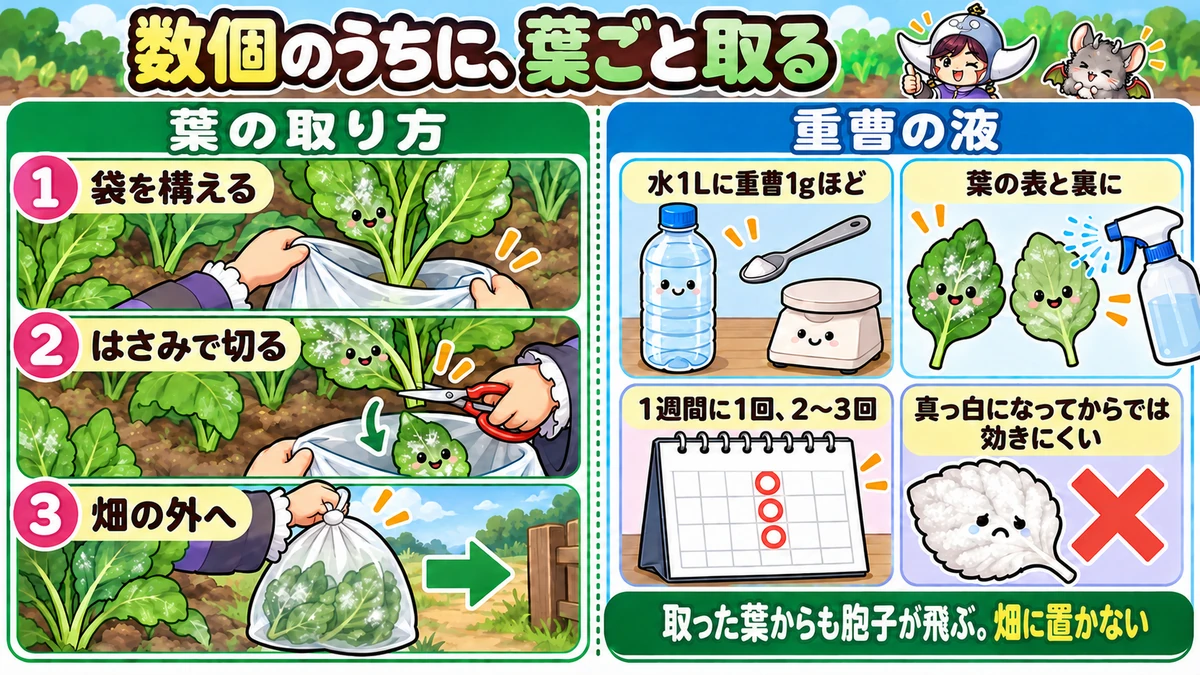
What this diagram says (図解の文字)
- While there are only a few spots, remove the whole leaf
- "Removing leaves": "① hold a bag ready" → "② cut with scissors" → "③ off the plot"
- "Bicarbonate spray": "about 1 g of bicarbonate per litre of water" / "top and underside of the leaves" / "once a week, 2–3 times" / ✕ "doesn't work once it's gone pure white"
- "Removed leaves release spores too. Don't leave them on the plot"
⑤ End of season, tunnels and balconies
When the summer harvest is over, clear affected plants completely — piling mildewed leaves and vines on the bed spreads spores to whatever's growing nearby. If it was a bad year, review spacing, leaf clearing, feeding and position, and note what you learned in your garden diary. Small changes each year make a big difference.
Tunnels — spring peas, autumn cucumbers — trap still air. Open the ends on warm days. On balconies, containers against a wall or under an overhang get it more; move them a little away from the wall and leave space between containers.
⑥ Telling it from look-alikes
- Downy mildew: common on cucumbers too — angular yellow spots boxed in by the veins on top, greyish mould underneath. It spreads in wet weather. Remove affected leaves promptly
- Natural leaf markings: some courgettes and squash have silvery patterns along the veins — not disease. Rub it with a finger: mildew comes off as powder; markings don't
- Aphid skins: scattered white specks rather than a spreading powder
- Spider mites: faint, speckled whitish dots on the leaf; nothing rubs off. Look underneath for the mites
- Grey mould: fluffy, cotton-wool grey mould on flowers, fruit and damaged leaves, not a thin flat powder
- Dirt, lime or dust: washes off with water, and isn't in round spots
- Sooty mould: black, not white — mould growing on honeydew from aphids and the like
⑦ Crop by crop
- Cucumbers: very prone. Wider spacing, clear lower leaves, avoid both over- and under-feeding. More curved or tapering fruit can be a sign of a tired plant
- Squash and courgettes: big leaves, overlapping vines. Thin the vines and plant early so the harvest comes while plants are vigorous. Remember courgettes' natural silver markings
- Melons and watermelon: mildew while the fruit is growing can affect sweetness. Check from the bottom; remove leaves early
- Aubergines, peppers, tomatoes: late summer, as they tire. Clear the bottom 1 ft of leaves; keep up feeding and watering
- Peas and snap peas: spring, as they bulk up. Cut finished and thin stems; resistant varieties if it's yearly
- Strawberries: keep removing old and dead leaves at the base
- Okra: late summer on lower leaves. The leaves below each picked pod can go with little effect on the plant — clear them as you harvest
- Bitter gourd: fairly tough, but a dense green screen gets it on the inner leaves. Spread the vines
⑧ Where growers disagree, and common mistakes
- Dry or damp? You'll hear both. In practice it often spreads when dry days follow a damp spell, or when day–night swings are large — a combination of conditions. Don't think in only one direction
- How well does bicarbonate work? Most agree: useful at the start, weak once it's widespread
- Remove every white leaf, or some? Some remove spotted leaves at once; others remove the worst a few at a time, because stripping many leaves weakens the plant. Take the worst first, over several days, and keep the healthy upper leaves
- Leaving white leaves → they keep spreading spores
- Leaving removed leaves on the plot → spores still fly. Bag them and take them away
- Packing plants in → overlapping leaves, more mildew
- Feeding to "perk it up" → softer, lusher growth that spreads it. Stick to normal rates
- Making the bicarbonate stronger → leaf damage. About 1 g per litre
Milk sprays? Some report diluted milk slowed it, but milk left on leaves can smell and grow other moulds. Can you eat the vegetables? Yes — it's a plant disease that doesn't affect people; wash off any powder on the fruit. Same spot every year? Spores blow in from elsewhere; it's more likely the same growing habits and the same airflow conditions each year.
Science bit: four whys 🔬
Why only on the surface of living leaves? Powdery mildew fungi can only feed on living plants — they can't grow on dead leaves. So rather than rotting the leaf from inside, they spread over its surface and feed while keeping it alive. That's why a white leaf doesn't die at once — but its photosynthesis falls all the while, and the plant slowly weakens.
Why does it spread in dry weather? Most fungi need a film of water on the leaf for their spores to germinate — hence rain and dew. Powdery mildew spores are said to germinate without wet leaves, given some humidity in the air; and on dry, clear days the spores blow about more easily. Humid nights and dry days suit it perfectly.
Why does nitrogen encourage it? Plenty of nitrogen pushes the plant to grow big leaves fast, and the leaf surface's defences don't fully develop — soft leaves that are easy to colonise and feed on. Big, dense leaves also trap still air.
Why bicarbonate? Dissolved in water it's mildly alkaline. Sprayed on the leaf, it's thought to change the surface conditions so the fungus grows poorly — and since the fungus lives on the surface, that's where it works. It can't remove fungus that's well established, which is why it's an early-stage treatment, and why too strong a mix harms the leaf surface itself.
Why lower leaves first? They're the oldest, with weaker defences than young leaves; they're shaded by the leaves above; and the air near the ground is stiller. A perfect starting point.
To sum up
- ✅ The white powder is the fungus; it starts low and spreads on the wind
- ✅ Squash family especially; also aubergines, peppers, tomatoes, peas, strawberries, okra
- ✅ It spreads even in dry spells
- ✅ Triggers: crowding, shade, too much nitrogen, tired plants
- ✅ Wider spacing, clear lower leaves, spread the vines
- ✅ Neither too much nor too little fertiliser; don't let it run dry
- ✅ Remove spotted leaves early, with scissors, into a bag, off the plot
- ✅ Bicarbonate about 1 g per litre, both sides, weekly, 2–3 times, at the start
- ✅ Rub it: powder comes off = mildew
- ✅ Clear affected plants completely at the end of the season
Powdery mildew is hard to stop once it's everywhere — but at the few-white-spots stage it's very manageable. Next time you walk round, look at the lowest leaves first 🍃
Thank you for reading!