Mizuna, pak choi and radishes: one method, three quick crops 🌱 Sowing, thinning, winter covers and picking
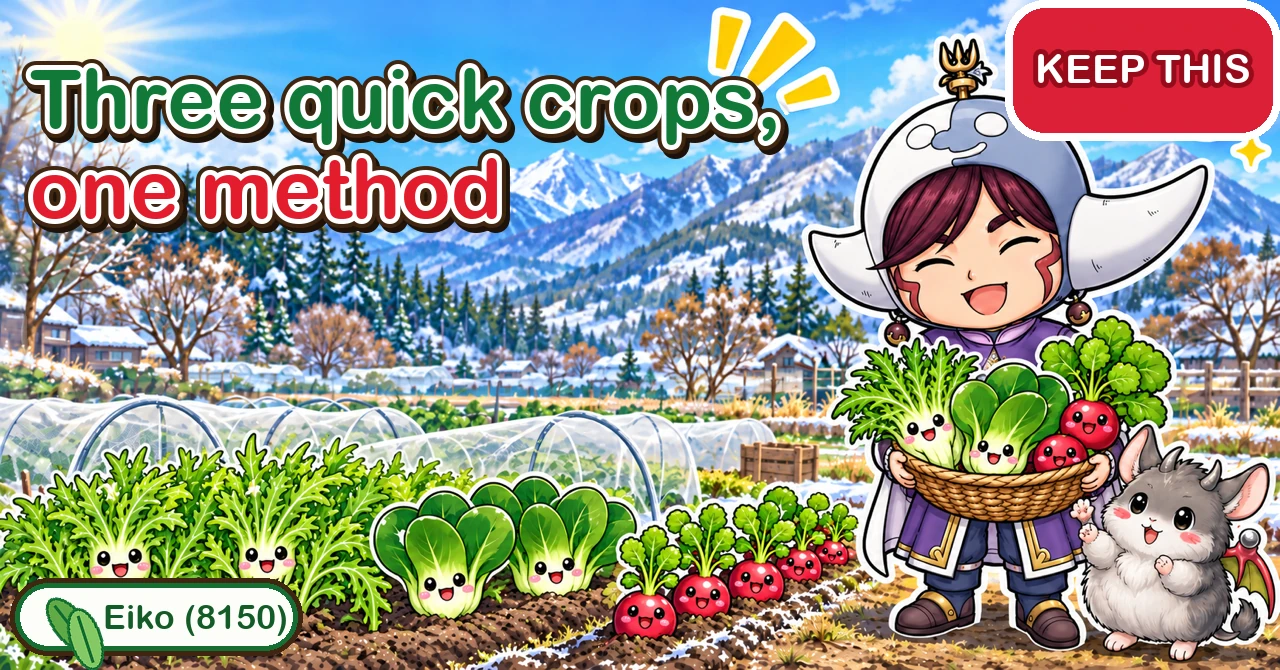
🌱 "I wanted something I could pick quickly."
🌱 "My 'twenty-day' radishes took far longer than twenty days."
🌱 "My mizuna's leaf tips went brown in winter."
Hello, I'm Eiko. Eight years of growing vegetables organically and without pesticides, and a teaching licence in science.
Sow them in a gap in the bed, in the space left when summer crops come out, or in a single container — and they're on the table in no time. Mizuna, pak choi and radishes are the classic quick crops.
All three are brassicas, so the basics are the same. What differs is the part you eat, how you pick it, and how well it takes the cold. This article covers all three together: what they share, and where they part ways.
How to use this article. I garden in central Japan, roughly USDA zone 8b–9a, with the last frost in early spring and the first in late November. Timings are given relative to your frost dates.
Shared basics. Family: brassicas. Sow about ½ in (1 cm) deep, firm it hard, then fleece and insect netting. Go easy on fertiliser. Harvest in roughly one to two months.
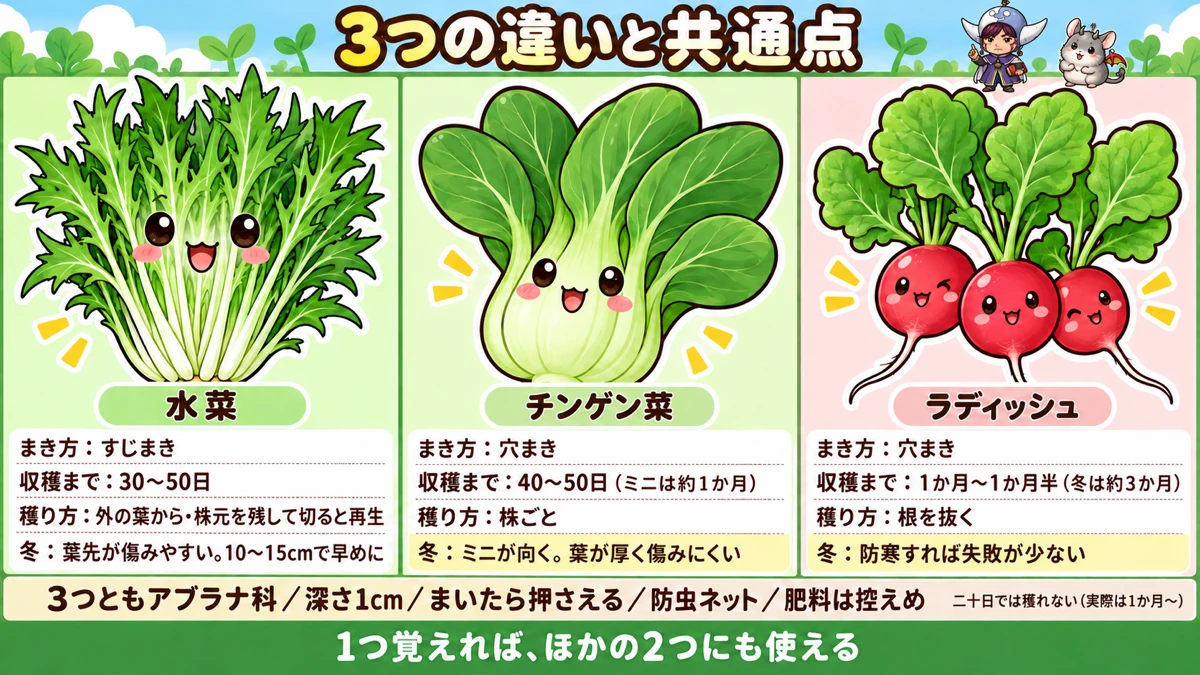
What this diagram says (図解の文字)
- How the three differ, and what they share
- "Mizuna" — "sow in drills" / "to harvest: 30–50 days" / "pick outer leaves, or cut leaving the base and it regrows" / "winter: leaf tips get damaged — pick early at 10–15 cm"
- "Pak choi" — "station-sow" / "40–50 days (mini types about a month)" / "pick whole" / "winter: mini types suit it — thick leaves resist damage"
- "Radish" — "station-sow" / "1 to 1½ months (about 3 in winter)" / "pull the root" / "winter: few failures if protected"
- "All brassicas / 1 cm deep / firm after sowing / insect net / light on fertiliser" / "not ready in twenty days (really a month or more)"
- "Learn one and you can grow the other two"
① Meet the three
- Mizuna — masses of fine, deeply cut leaves from the base. Crisp raw in salads and a must in Japanese hotpots. Big plants are bulky, and you can cut what you need and leave the rest. There's a purple-stemmed type too; its seed is tiny, so drop 2–3 seeds at a time to save thinning
- Pak choi — thick, fleshy leaves on a swollen base; excellent stir-fried. Like many Chinese vegetables, it copes with both heat and cold, so it grows well in early summer when other leafy crops struggle, and in winter too. Mini pak choi, harvested at under half the size, is quick and especially good for home gardens
- Radishes — small red roots (also white, purple, long and two-tone). Easy to swell, and a classic first crop. Some strains promise a high share of well-shaped roots. They're also good practice for raising seedlings before you start tomatoes or aubergines in spring
Radishes are sometimes called "twenty-day radishes" in Japan — but twenty days is optimistic. Allow a month to six weeks, and about three months in winter.
② Long sowing seasons
- Mizuna: spring to autumn — from about a month before your last frost until about six weeks before your first. Sown two or three weeks before the first frost, it's ready in midwinter, just in time for hotpot season; put a tunnel over it once the real cold arrives. Water it well right after sowing — growers say it grows bigger and keeps going better
- Pak choi: one packet gave from about a month before the last frost until around the first frost. Mini types can be sown in late winter
- Radishes: in central Japan, from about a month before the last frost until a week or two before the first
Being able to sow the moment a bed comes free is their great advantage.
- Autumn balances quick growth and fewer insects. Pak choi sown in early autumn was ready in about a month; a month later it takes a little longer, about 40 days
- Spring is fast but the insects are waking up. Spring-sown mizuna is crisp and good; in the heat of summer it gets harder
- Summer pak choi grows fine, but insects are at their worst — netting is non-negotiable
- Winter works with protection. From around the first frost onward, it gets hard without proper covers — though mini pak choi and radishes still manage
③ Soil and fertiliser
All three are short crops that need little feeding. Where another crop has just been, what's left is usually enough. For winter sowings, try with nothing and top-dress a little later if growth is poor.
Does sowing straight after fertilising really matter?
One grower tested the usual advice — "wait two weeks after fertilising" — on ground that had been empty for about a year, with three plots:
- No fertiliser
- Bokashi made three weeks earlier, sown straight away
- Leaf mould and rice bran (about 2 litres and 200 ml per square metre) added and sown the same day
Within 4–5 days the difference was clear. The no-fertiliser and bokashi plots came up almost completely; the same-day plot germinated poorly. Afterwards the bokashi plot grew best, the unfed plot grew slowly and small, and even the seedlings that did emerge in the same-day plot grew poorly.
So: fertilise 2–3 weeks ahead. If there's no time, sow without, or use something already broken down like bokashi.
All three share a family with komatsuna, turnips, radish and Chinese cabbage. Following brassica with brassica can bring more aphids and caterpillars — though in an organic garden with a varied rotation, one or two repeats usually don't cause much trouble.
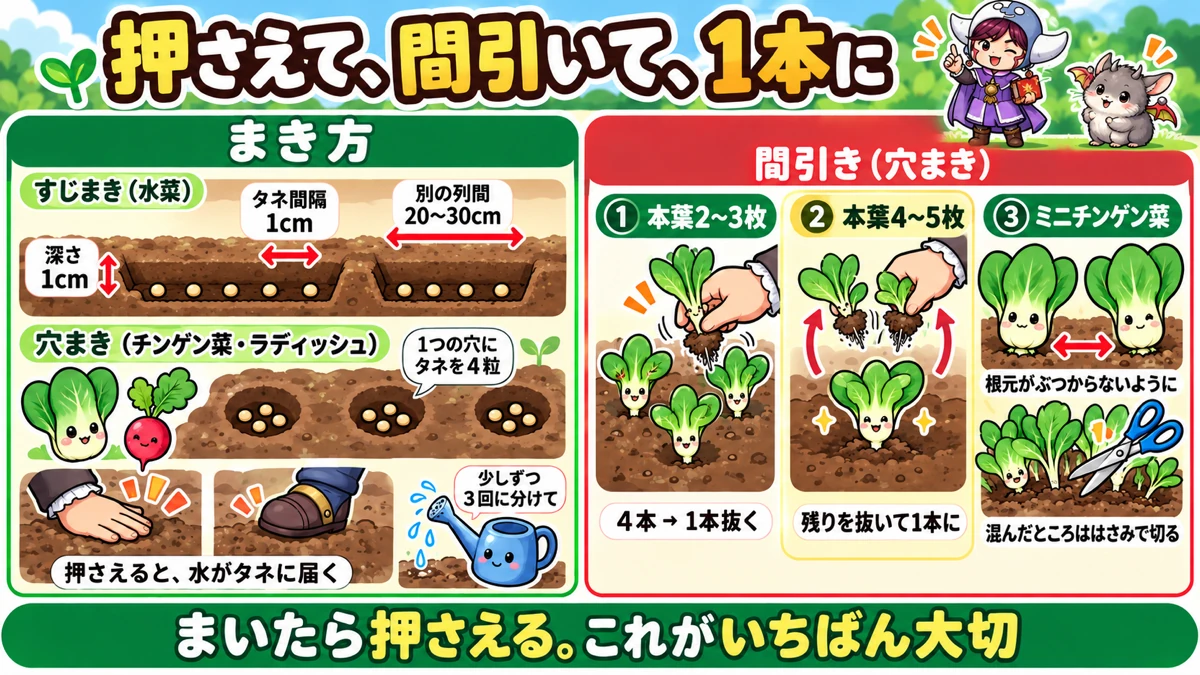
What this diagram says (図解の文字)
- Firm it, thin it, leave one
- "Sowing" — "drills (mizuna)": "seeds 1 cm apart", "1 cm deep", "next row 20–30 cm away"
- "Station sowing (pak choi, radish)": "4 seeds per hole"
- "Firming lets water reach the seed" / "a little at a time, in three goes"
- "Thinning (station-sown)": "① 2–3 true leaves: 4 plants → pull 1" / "② 4–5 true leaves: pull the rest, leave 1" / "③ mini pak choi: keep the bases from touching" / "cut crowded spots with scissors"
- "Firm after sowing — that matters most"
④ Sowing
The shared steps
- Make a hole or drill about ½ in (1 cm) deep
- Sow, cover from the sides
- Firm hard with your palm — as if leaning your weight on it
- Water
- Fleece on top, then insect netting over that
Firming came up again and again from every grower. It puts seed and soil in contact and stops the moisture escaping. Left loose, the seed sits in an air pocket and water never reaches it. For a long drill, some growers simply walk along the row to firm it.
Water in small doses — a little, let it soak, again, about three times. Start the can off the bed; 5–10 seconds of watering is enough.
If you're sowing only a few, you can pre-sprout the seed on damp fleece or gauze first.
Station sowing: pak choi and radishes
- Radishes: 4 seeds per hole, pressed in a little, covered and firmed
- Pak choi: about 4 per hole — or four little 1 cm holes with one seed each. In warm weather 2–3 per hole is usually enough; in cold weather sow 4–5. In winter, mulch holes that are too big let the soil cool
Drills: mizuna
- A ½ in (1 cm) drill, one seed about every ½ in (1 cm)
- Cover from both sides and firm
- Rows 6–8 in (15–20 cm) apart for mizuna; when mixing crops in one bed, 8–12 in (20–30 cm) between rows so leaves don't overlap
In winter, drills give mizuna better germination and a bigger crop. To sow a drill through mulch film, slit the film with a craft knife and make the drill in the slit.
Mixing with lettuce or crown daisy
Alternating rows of these brassicas with lettuce or crown daisy (which insects tend to avoid) may help deter pests. Mizuna's cut leaves already make it one of the less-targeted brassicas. Sow the brassicas ½ in (1 cm) deep, but lettuce and crown daisy only ¼ in (5 mm) — they need light to germinate.
Germination
In warm weather all three come up within days — radishes in about 3–5, leafy brassicas in about 4. If nothing's appeared well after that, re-sow promptly; in autumn every week's delay costs growth. In warm weather, take the fleece off once they're all up.
⑤ Thinning
- Pak choi and radishes (station-sown): at 2–3 true leaves, pull one; at 4–5 true leaves, thin to one per hole
- Mini pak choi: the base swells as it grows, so space them so they don't touch — or they grow lopsided
- Crowded clumps: snip with scissors at soil level rather than pulling, so you don't disturb the ones you keep
- Eat the thinnings. Tiny radish leaves look lovely scattered over a dish
⑥ Insects
All three are brassicas and insects love them. From spring to autumn, put a netting tunnel on as soon as you sow — and above all, bury the edges with no gaps. Any gap is a way in.
Aphids can still turn up, through a gap or from the soil. While there are few, brush them off and rinse with water.
Radish seedlings are especially prone to flea beetles early on; lots of small holes in the first leaves weaken the root. Net immediately after sowing.
Winter sowings have almost no insect trouble — radishes come out with clean leaves and bright colour.
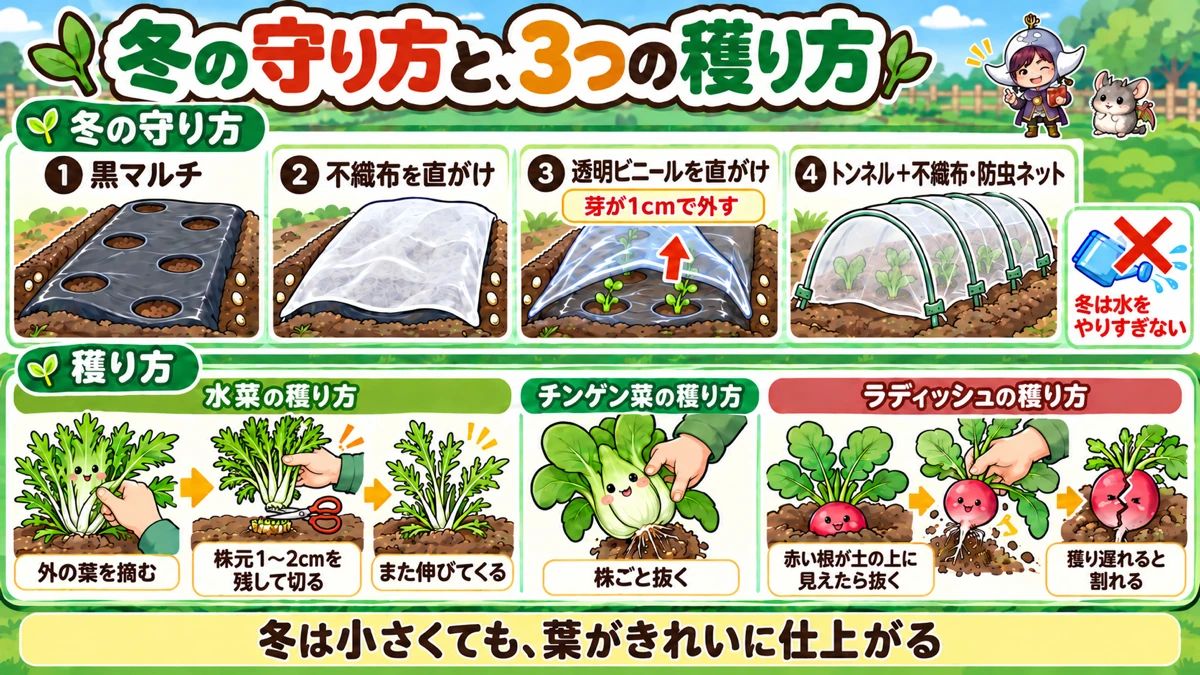
What this diagram says (図解の文字)
- Winter protection, and how to harvest each one
- "Winter protection": "① black mulch" → "② fleece laid directly on" → "③ clear polythene laid directly on — take it off when shoots are 1 cm" → "④ tunnel + fleece + insect net" / ✕ "don't overwater in winter"
- "Harvesting mizuna": "pick outer leaves" → "cut leaving 1–2 cm at the base" → "it grows back"
- "Harvesting pak choi": "pull the whole plant"
- "Harvesting radishes": "pull when the red root shows above the soil" → "leave them too long and they split"
- "Small in winter, but the leaves come out clean"
⑦ Winter growing
Mini pak choi and radishes are the best winter performers. Komatsuna and mizuna tend to get brown, damaged leaf tips in the cold; mini pak choi's thick leaves resist it. Radishes are easier than turnips or big radishes in winter, which can bolt in spring before they've swelled — protected, radishes reliably give small roots.
- Black mulch first — without it the soil stays cold and dries out
- Fleece laid directly over the sown bed
- Clear polythene laid directly on top, weighted at the corners
- Once they're up: a polythene tunnel with fleece or netting over it, edges clipped firmly against winter wind
Take the direct polythene off once the shoots are about ½ in (1 cm) tall. Even winter sun heats up the space underneath, and new shoots weaken.
Don't overwater. Each watering chills the soil. Water well right after sowing, then hardly at all.
Midwinter sowings stay small even under good covers — but small leaves make excellent baby leaves. Winter mizuna doesn't grow tall; pick it at about 4–6 in (10–15 cm).
Two planning notes: don't sow winter crops in beds meant for spring-planted summer crops, or they'll still be occupying the space when you need to prepare it. And a fun one: sow a mixed-colour radish packet in early winter under a tunnel, and aim for the first harvest of the new year.
⑧ Harvest
Mizuna: pick a little, enjoy it for longer
- Pick outer leaves in turn — new ones keep coming from the centre, and the plant spreads and yields more
- Or cut the whole plant leaving ½–¾ in (1–2 cm) at the base — like chives, it regrows for another cut
Don't let it get too big: the stems toughen. For eating raw, pick young.
Pak choi: whole plants
When the base has filled out, pull or cut the whole plant. Mini pak choi is lovely blanched on noodles or stir-fried.
Radishes: check the size and pull
When the red shoulder shows above the soil, check its size and pull. Left too long, they go hard or split. Pull the ready ones first.
Bolting
In spring, pak choi and mizuna send up flower stems. Pak choi buds can be eaten like flowering greens — pick them tender, before the flowers open.
⑨ Containers and companions
- All three suit containers. In a large one with a bag of potting compost, sow each crop in its own row
- A container with slits in the base doesn't need a layer of stones. A large one holds about 25 litres of compost
- Pak choi from plants is quicker: about a month from planting, versus two months from seed
- Water until it runs out of the bottom after sowing or planting
- Windbreaks for beans: sown between overwintering broad beans or peas, radishes and mini pak choi spread their leaves and shelter the young bean plants
- Fill gaps between other crops, and sow little and often for a running harvest
- Mini daikon sits between a radish and a full-size daikon and can be grown the same way, several to a hole
- Leftover seed: mix mizuna, mustard greens, komatsuna and lettuce seed and broadcast it in a winter corner, then add radishes — a patch of mixed baby leaves
⑩ Where growers disagree, and common problems
- Picking mizuna: outer leaves bit by bit, or cut it all leaving the base. Either way the plant stays and crops again
- Seeds per hole for pak choi: 2–3 normally, 4–5 in cold weather, or one each in four little holes. Fewer when germination is easy
- Radishes not ready at twenty days → normal. Allow a month to six weeks
- Brown mizuna tips in winter → pick small and early, or grow mini pak choi instead
- Shoots weakened under polythene → take direct polythene off as soon as they're up
- Holes despite the net → check the edges for gaps
- Tough mizuna → left too big. Pick young, outer leaves first
- Pak choi slow to come up → leafy brassicas germinate best at about 59–77°F (15–25°C), in roughly four days. Well past that, re-sow
Which is easiest? Every grower named radishes. And for a first pak choi, mini pak choi — about a month, fewer failures, and it tastes the same.
Science bit: why these three are so quick 🔬
Cabbages and Chinese cabbages stack dozens of leaves into a head, which takes a long time. Mizuna and pak choi are eaten young, after just a few leaves, and radishes are pulled while the root is still small. That's the whole secret of their speed.
And because they're so quick, they can use just the good part of a hot or cold season — slipping in between other crops when nothing else would make it.
Germination needs warmth, water and — for some seeds — light. Light-loving seeds like lettuce and crown daisy struggle if buried deep, so they go in at ¼ in (5 mm). These three brassicas go in at ½ in (1 cm).
And winter sweetness? Growing slowly in the cold, the plants are said to build up more sugar — winter pak choi in particular is praised for it.
To sum up
- ✅ All brassicas, long sowing seasons, ready in one to two months
- ✅ "Twenty-day" radishes really take a month to six weeks
- ✅ ½ in (1 cm) deep, firm hard, water in small doses
- ✅ Pak choi and radishes in stations, mizuna in drills
- ✅ Thin at 2–3 and 4–5 true leaves to one
- ✅ Netting with buried edges
- ✅ Winter: mini pak choi and radishes. Black mulch and layered covers; take direct polythene off once they're up
- ✅ Mizuna crops again and again — outer leaves, or a cut above the base
- ✅ Fertilise 2–3 weeks ahead, or not at all
All three fit into a gap in the bed or a single container. Find an empty spot and sow just one of them 🌱
Thank you for reading!