Turnips: four seeds a hole, thinned three times to one 🌱 Sowing, thinning, insects and winter turnips
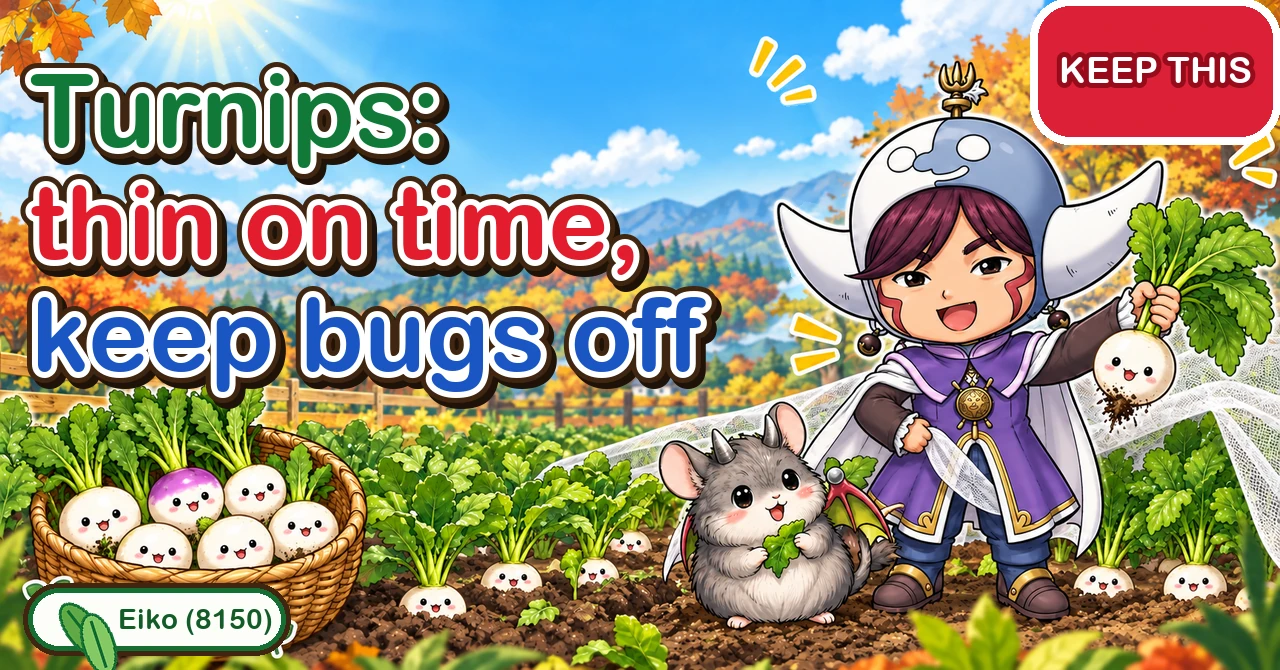
🌱 "The leaves were eaten to lace."
🌱 "They never rounded out."
🌱 "They split."
Hello, I'm Eiko. Eight years of growing vegetables organically and without pesticides, and a teaching licence in science.
Turnips are lovely raw in salads, pickled, or simmered — and the leaves are good stir-fried too. They're quick and don't take much room, which makes them a favourite in small gardens.
They're easy, as long as you get three things right: sowing, thinning on time, and keeping insects off. This article goes through them in order, plus the winter covers that give you small, sweet turnips in the cold.
How to use this article. I garden in central Japan, roughly USDA zone 8b–9a, with the last frost in early spring and the first frost in late November. Timings are given relative to your frost dates.
Basics. Family: brassicas. Sow: spring (around your last frost) and autumn (the easiest — from late summer). Depth: about ½ in (1 cm). Station sowing: 4 seeds every 6 in (15 cm), thinned three times to one. Small turnips: roughly 6–8 weeks from an autumn sowing; longer in the cold.
① When to sow
Autumn: the best bet
There are two sowing seasons, spring and autumn, and autumn is the one most often recommended to beginners: fast growth, well-shaped roots, and insects fading as the heat goes. Sown in early autumn, small turnips can be ready in little more than a month. The start of autumn is still buggy, though, so net the moment you sow.
Early autumn sowing grows bigger roots
Root crops build their leaves first, then store what those leaves make in the root. Big leaves while it's still warm mean a big root later. For large turnips, radishes or carrots, the usual advice in central Japan is to have them sown by October — roughly six weeks or more before the first frost.
Very early sowings can meet late heat. Cover seedlings with fleece or shade cloth, and don't whip the fleece off the moment they come up — a common way to scorch them. Leave it loosely on until the plants have some size. Water only when the soil is dry.
Winter: no insects, sweeter, but small
Sown around the first frost with protection, turnips still grow. Winter brings real advantages:
- Almost no insect damage — clean leaves
- Chafer grubs in the soil go quiet, so roots don't get gnawed
- Few aphids
- Cold makes them sweeter
But growth is very slow, and they stay small. Sow winter turnips planning to harvest small ones.
Spring
In central Japan, sow from early to mid-spring — around the last frost — and harvest in late spring to early summer. Some strains can be sown earlier under a tunnel; check the packet. A sowing a few weeks after the last frost also works well: warm soil, quick germination and growth, and turnips before the summer crops get going. There are more insects in warm weather, but you're eating the root, so a few holes in the leaves don't matter much.
What turnips like: some packets give about 68–77°F (20–25°C) as the best for germination and 59–68°F (15–20°C) for growth — a little warmth to start, then cool. Sow little and often for a steady supply rather than a glut.
② Choosing seed
- Size: small, medium and large turnips are all available, up to huge ones. In a home garden, small turnips are the easiest start
- A rough guide: a small turnip can reach 1–1¼ in (2–3 cm) across in about six weeks if kept warm; a standard one takes around ten weeks to reach a fine 1½–2 in (4–5 cm)
- Size by spacing: some strains can be harvested small, medium or large just by changing the spacing — though a late sowing may not get to full size. The same strain might only make a small turnip from an early-winter sowing, but grow large from a late-winter one
- Slow to split or go pithy: some strains are described this way, so they hold in the ground a little after they're ready — useful if you can't eat them all at once
- Coloured turnips, such as ones with purple shoulders, are fun and look lovely pickled
- For cold sowings, look for strains that swell well in the cold, and for resistance to white rust or clubroot
③ Soil and fertiliser: go easy
Turnips don't need much fertiliser. Where another crop has just come out, you can usually sow without adding any. In fact, too much brings insects and misshapen roots.
A side-by-side test
One grower sowed the same small turnip on the same day in beds with different amounts and kinds of fertiliser, and compared them a month later:
- Best: a moderate amount of leaf mould and rice bran — even germination, clean leaves, almost no insects
- A generous amount of home-made compost: nearly as good, but the beds with more had started to attract insects
- Leaf mould and rice bran at three times the amount or more: overdone — poorer growth and more insects
- Plenty of cow manure, oilseed cake and chicken manure: mediocre growth, with insects
- Nothing at all: slow to germinate and slow to grow
One test in one garden — but it shows nicely that too little slows them down and too much invites insects.
Other soil points
- Leave 2–3 weeks between adding fertiliser and sowing. Gases from breakdown can damage seed. If that would make you sow too late, sow straight into a bed where summer crops grew, with nothing added. On fresh ground with no time, one grower adds bokashi and sows straight away — about 2 litres per square metre
- Remove stones near the surface; roots that hit them go lopsided or fork
- After soil solarisation, don't dig deep — you'd bring untreated soil, pests and weed seed back up
- Pick out grubs as you dig, and clear away old leaves if the last crop had aphids
- Bed width: about 2 ft (60 cm) for one row; about 3 ft (1 m) for two rows about 1 ft (30 cm) apart. Allow more for large turnips
- No need for a high bed. Turnips push up out of the soil as they grow
- Planting-hole mulch keeps weeds down and warms the soil — important for later sowings
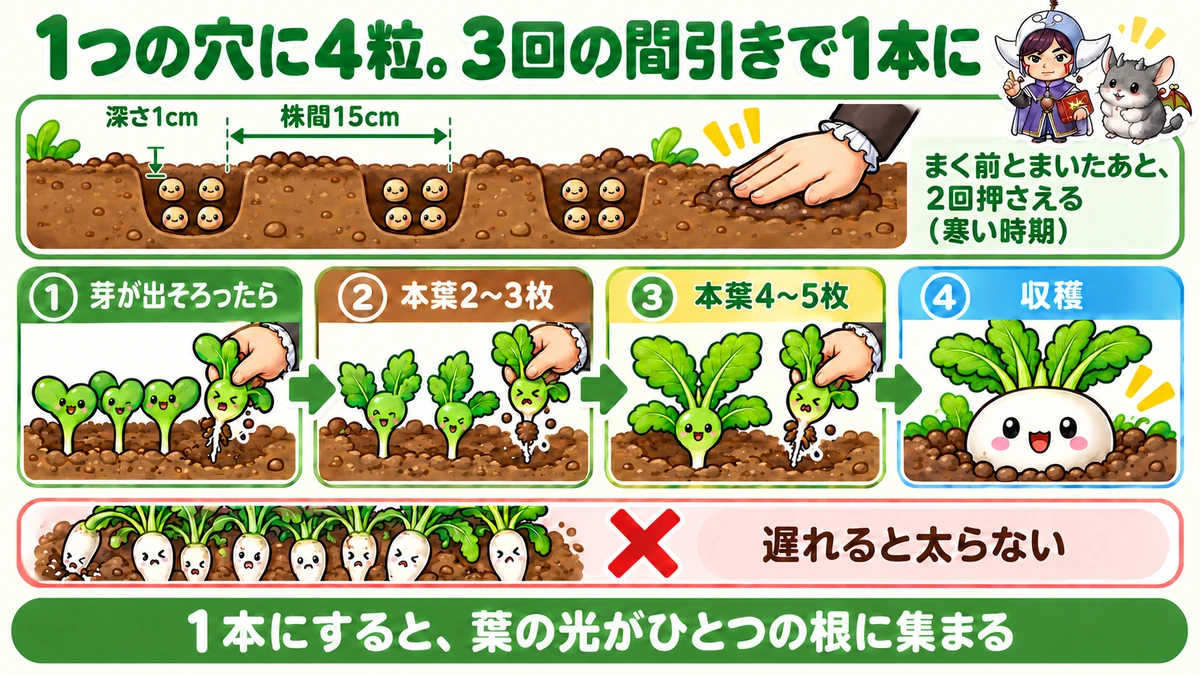
What this diagram says (図解の文字)
- Four seeds a hole. Thin three times to one
- "1 cm deep", "15 cm apart" / "press twice, before and after sowing (in cold weather)"
- "① Once they're all up" → "② 2–3 true leaves" → "③ 4–5 true leaves" → "④ Harvest"
- ✕ "Thin late and they won't swell"
- "Down to one, and all the leaves' light goes into one root"
④ Sowing
Station sowing
- Make holes ½ in (1 cm) deep, 6 in (15 cm) apart
- Sow 4 seeds per hole, a little apart — some won't come up
- Cover, press down with your palm, and water
Depth matters: too deep and they're slow to appear; too shallow and, especially in cold weather, they may not come up at all.
In cold weather, press twice — firm the spot before sowing, and again after covering. It puts seed and soil in close contact so moisture reaches the seed.
Drills
Turnips suit drills too: a ½ in (1 cm) drill, sow thinly, cover, firm, and thin as they grow. Handy for a neat row of small turnips.
Water a little at a time
A big splash washes seed away. Water a little, wait 10–20 seconds, and repeat about three times — it soaks in far better. Start and stop the can off the bed.
Fleece, then netting
Lay fleece straight over the bed: it stops heavy rain washing seed out, keeps the soil moist, and adds warmth in the cold. Weigh the corners with soil. Then put insect netting over the top, tight with no gaps, edges buried — butterflies get in through any gap at the bottom.
⑤ Thinning: three times, on time
- 1st: about a week after they're all up, remove the weakest
- 2nd: at 2–3 true leaves (the jagged ones), remove another
- 3rd: at 4–5 true leaves, leave the strongest one
Why not go straight to one? So you have spares if insects or disease take some.
Don't be late. Roots tangle and you pull up the one you meant to keep; and with several still in the hole as the roots start to swell, they all stay small. Thinning left until late autumn may be too late for them to size up. Get them down to one while they're small and they still have a chance.
After thinning, if the remaining plant wobbles, draw soil round it from both sides. Loosening the soil lightly between plants lets air in and helps the roots. And eat the thinnings — leaves, tiny roots and all — in soup, blanched or quick-pickled.
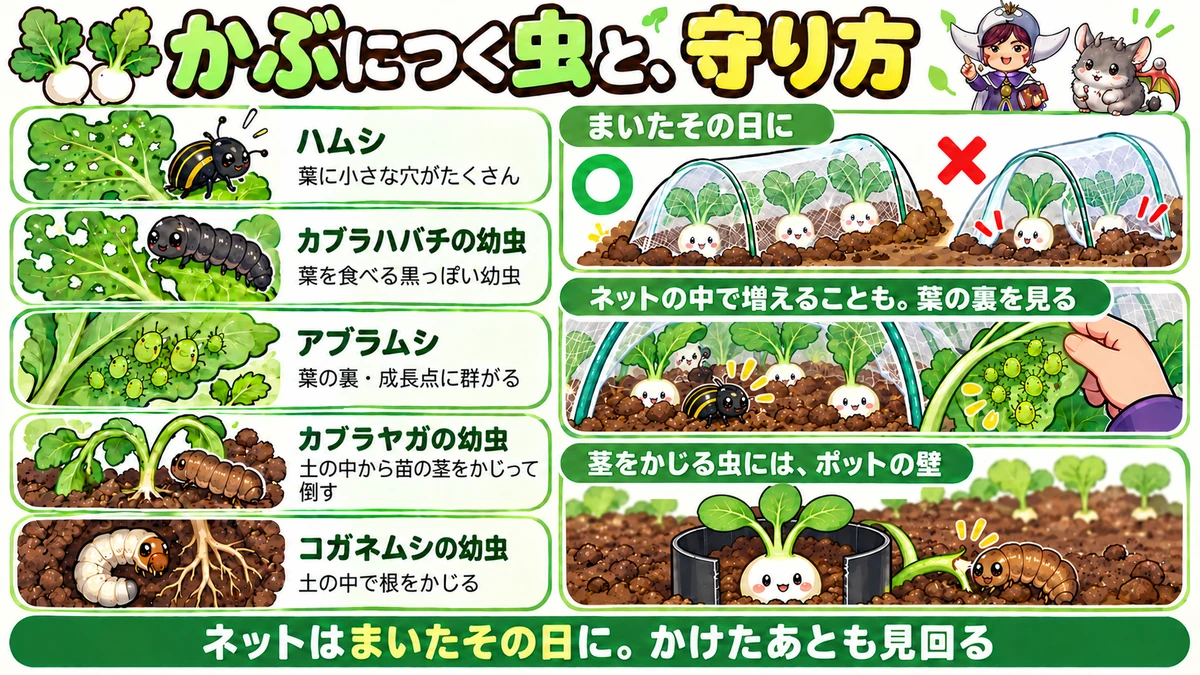
What this diagram says (図解の文字)
- The insects that go for turnips, and how to protect them
- "Flea beetles" — "lots of small holes in the leaves" / "Turnip sawfly larvae" — "blackish larvae that eat the leaves" / "Aphids" — "crowd under leaves and at the growing tip" / "Cutworms" — "come out of the soil and chew through seedling stems" / "Chafer grubs" — "chew roots underground"
- "The day you sow" ◯ net on / ✕ no net
- "They can multiply inside the net too. Check under the leaves"
- "For stem-chewers, a pot wall"
- "Net the day you sow — and keep checking afterwards"
⑥ Insects: the big challenge
Turnips are one of the most insect-loved brassicas. Growing without sprays, this is the hard part.
- Turnip sawfly — common enough on turnips to be named after them. The blackish larvae eat the leaves
- Flea beetles — small beetles that pepper leaves with holes and also scar the surface of the turnip
- Aphids — under leaves and around the growing tip
- Caterpillars — large holes
- Chafer grubs — gnaw roots underground
- Cutworms — hide in the soil and chew through seedling stems
Net it — and keep checking inside
In one side-by-side sowing, the unnetted bed was badly damaged and the netted one had very little. But a net isn't the end of it: flea beetles hiding in the soil can emerge inside and multiply. Caterpillars are kept out; soil-dwellers aren't. Lift a few leaves every week or two and look underneath.
More ways to help
- Solarise in summer: clear plastic over the bed to heat the soil reduces eggs and larvae
- Aphids multiply from a few to thousands fast. Brush them off onto the mulch with a soft brush and spray them with a little oil and soap in water. Look first near the growing tip, where the wind doesn't reach, and on leaf undersides close to warm mulch
- Cutworms: a seedling snapped off at the base is a likely sign. Slip a plastic pot with the bottom cut off over the plant and push it slightly into the soil — a wall they can't cross. It won't stop chafer grubs, which come from below; pick those out when you dig
- Choose the spot and season: beds just cleared of ginger or taro tend to have fewer turnip pests, and winter sowings have almost none
- Mixing in lettuce or crown daisy may help deter insects
Disease
White rust: pale, blurry spots on top of the leaf, raised white blisters underneath. Remove affected leaves; prevent it with moderate feeding, good spacing and good drainage. Clubroot: swollen roots and poor growth — don't follow brassicas with brassicas, and choose resistant strains.
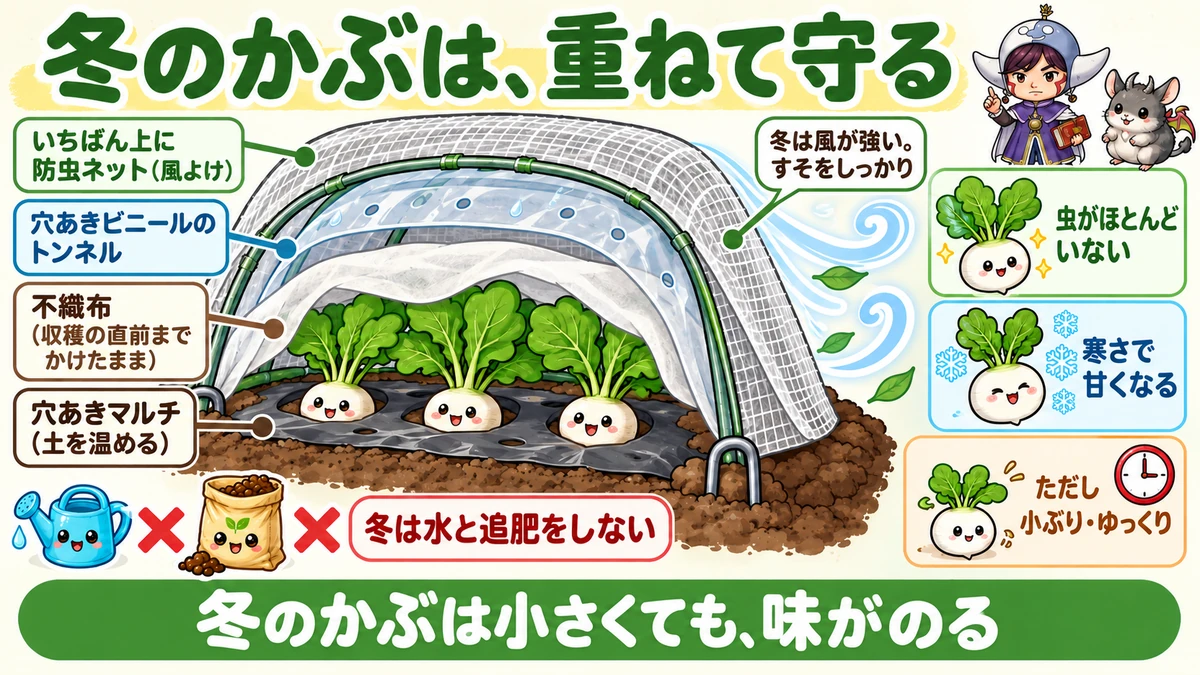
What this diagram says (図解の文字)
- Protect winter turnips in layers
- Top to bottom: "insect net on top (windbreak)" / "perforated polythene tunnel" / "fleece (left on until just before harvest)" / "planting-hole mulch (warms the soil)"
- "Winter winds are strong — fix the edges well"
- "Hardly any insects" / "sweeter in the cold" / "but small and slow"
- ✕ watering ✕ fertiliser — "no water or top-dressing in winter"
- "Winter turnips are small, but full of flavour"
⑦ Winter turnips
- Straight after sowing: fleece directly on the bed, left on until just before harvest
- Over that: a tunnel of perforated polythene
- Over that: insect netting — it holds the polythene down in winter winds and adds a little warmth
- Edges: fixed firmly with tunnel clips
As the leaves bulk up, add hoops to give them height.
Before you close a tunnel over autumn-sown turnips, get rid of the insects inside. Aphids shut in a warm tunnel are in paradise.
No watering or feeding in winter. When the turnips sit there small, it's tempting — but it chills the soil and can make it freeze. Without mulch, tuck straw or dry grass between the plants to keep the surface from drying.
Sown around the first frost, by midwinter you'll have little turnips. Pulled as thinnings, even ones about ½ in (1 cm) across have a charm of their own. Don't expect a turnip sown that late to grow as big as an early-autumn one — even from the same packet.
⑧ Containers
- Small turnips are fine in an ordinary, not-very-deep container with potting compost — no base fertiliser needed
- Don't fill to the brim, or water runs off before it soaks in. Stop at the fill line if there is one
- With few plants, you can space them at their final distance from the start and sow about 3 seeds per spot — much less thinning
- Press lightly and water until it runs out of the bottom. Use a saucer on a balcony or indoors
⑨ Harvest — and what comes next
When the white root is showing round above the soil, check the size and pull. Marble-size or ping-pong-ball size — both are delicious. Plan on about 60 days for an autumn sowing and you'll rarely be wrong.
- Late = split or pithy. Pick as they become ready
- For smooth skin, draw a little soil up round the base as they grow; if you don't mind, skip it
- Eat the leaves — stir-fried, blanched, in soup. Winter leaves are especially clean
- A turnip rising out of the soil is fine — it's a sign it's growing
Relay into peas: one grower sows snap peas between autumn turnips; the peas grow slowly at first, and the bed is used through two seasons. Otherwise, don't follow turnips with another brassica. Small turnips can also be squeezed between aubergines or peppers, where large radishes would get in the way.
⑩ Where growers disagree, and common problems
- Thinning steps: "one out when they're up, one at 2–3 leaves, down to one at 4–5" — or "to three when up, two at 3 leaves, one at 6–7." Both thin in three stages to one. If insects are bad, thin more slowly
- Fertiliser or none: both really ask whether there's any left in the soil
- Leaves full of holes → no net, late net, gaps at the edges, or insects that emerged inside
- Won't swell → late thinning, late sowing, or no cold protection
- Scars on the root → flea beetles. Net early and seal the edges
- Split → usually left too long
- Gaps in germination → autumn turnips come up in about a week; re-sow gaps promptly, since every week later means smaller roots
Science bit: how a turnip gets round 🔬
Leaves first, root second. For a while after sowing, the leaves race ahead while the root stays thin — even when the top looks like there must be a turnip down there. Once the leaves are big enough, the sugars they make in sunlight are sent down and stored, and only then does the root swell.
So protecting the leaves is how you grow the root. Leaves eaten by insects mean less food sent down. It's also why thinning matters: several plants in one spot share the light and the food, and all stay small. Thin to one, and all the light those leaves catch goes into a single root.
And winter turnips, grown slowly in the cold, are small — but cold makes them sweeter, and the slow growth gives a flavour of its own.
To sum up
- ✅ Spring and autumn — autumn is easiest. Sow early for big roots
- ✅ Winter: no insects, sweeter, but small. Fleece plus a tunnel
- ✅ Go easy on fertiliser; leave 2–3 weeks after adding any
- ✅ ½ in (1 cm) deep, 4 seeds a hole; press, and water a little at a time
- ✅ Fleece and netting the day you sow, edges buried — and check inside
- ✅ Thin three times to one, on time
- ✅ No water or feed in winter
- ✅ Pick when ready — late ones split
Turnips are quick and can be grown again and again through the year. Pick a packet that suits the season and start with four seeds to a hole 🌱
Thank you for reading!