Komatsuna: sow almost all year, but change what you guard against 🥬 Sowing, thinning, netting and winter covers
🥬 "Something ate it full of holes."
🥬 "I sowed in summer and nothing came up."
🥬 "I sowed in winter and it just sat there."
Hello, I'm Eiko. Eight years of growing vegetables organically and without pesticides, and a teaching licence in science.
Komatsuna — sometimes sold as Japanese mustard spinach — is a fast, mild leafy green from the cabbage family. In Japan it goes into stir-fries, soups and blanched side dishes almost daily, and it's one of the vegetables most often recommended to beginners.
It really is easy — as long as you grow it the way the season needs. This article is built around that: what to watch for in each season, then sowing, thinning, feeding, pests, containers and harvest.
How to use this article. I garden in central Japan, roughly USDA zone 8b–9a, where the last frost is in early spring and the first frost lands in late November. I've written timings relative to your frost dates.
Basics. Family: brassicas (with cabbage, Chinese cabbage, radish and turnip). Sow: about ½ in (1 cm) deep, one seed every ½–¾ in (1–2 cm) in a drill, then firm well. Thin once at 2–3 true leaves. Harvest: about a month after sowing in warm weather, around 40 days in autumn, about two months in the cold.
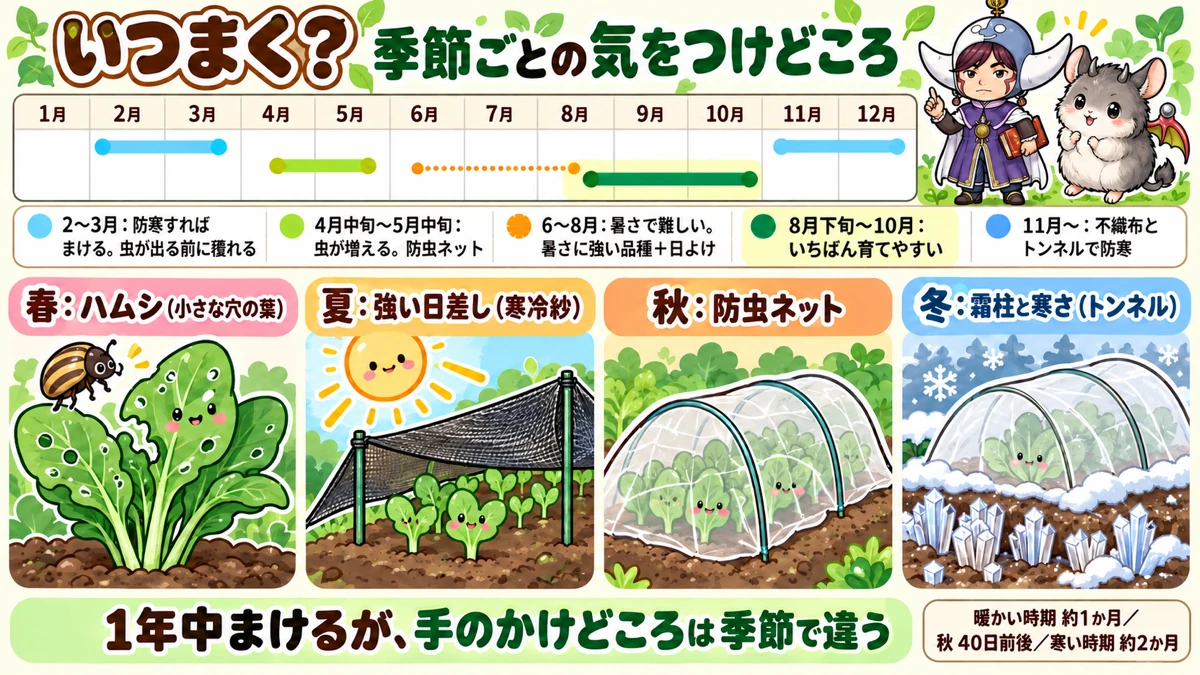
What this diagram says (図解の文字)
- When to sow? What to watch for in each season (months are for central Japan)
- "Feb–Mar: can be sown with protection; harvest before the insects appear" / "mid-Apr to mid-May: insects increase — net it" / "Jun–Aug: hard in the heat — heat-tolerant seed plus shade" / "late Aug to Oct: the easiest of all" / "Nov on: fleece and a tunnel for warmth"
- "Spring: flea beetles (small holes in leaves)" / "Summer: strong sun (shade cloth)" / "Autumn: insect netting" / "Winter: frost heave and cold (tunnel)"
- "Sow all year — but where you put the effort changes with the season"
- "Warm weather about 1 month / autumn about 40 days / cold weather about 2 months"
① Each season is a different job
- Autumn — the easiest. In central Japan that means sowing from late summer until about four weeks before the first frost. It's mild, growth is quick, and insects are on the way out. The early part of autumn still has plenty of them, though, so net it
- Winter — no insects, slow growth. The leaves come out spotless, and many people say cold makes the flavour stronger. But growth is slow: sown in early winter, a few weeks after the first frost, allow around two months. Without protection it may not come up, or not grow
- Spring — race the insects. Sown in late winter under cover, it's harvested before the pests get going. Sow later than that and you'll need netting; aim to finish spring sowing about 4–6 weeks after the last frost, because as summer arrives growth falls off in the heat
- Summer — hard, but possible. Heat and dry soil make germination poor, strong sun scorches seedlings, and insects are at their worst. Heat-tolerant seed and some shade make it workable (see ⑦)
Choosing seed: there are a great many komatsuna strains. The packet usually says what each is good at — "heat-tolerant", "cold-tolerant", "sow all year". Matching the seed to the season is half the battle. Some say flavour barely differs between strains; others swear by an old-fashioned one. Pick for the season first, then experiment with taste.
② Soil and fertiliser: often none needed
Komatsuna doesn't need much feeding. Where another crop has just been grown, what's left in the soil is usually enough — especially for autumn and winter sowings, which many growers start without adding anything. The beds where summer crops like leeks, tomatoes, taro or ginger have just come out are classic spots.
On new or poor ground, mix in compost or fertiliser about two weeks before sowing. Sowing straight into fresh fertiliser can damage the seedlings and roots.
Some growers say komatsuna hardly suffers from being grown in the same spot. But it is a brassica, and following other brassicas can bring clubroot and similar trouble, so it's safer after a crop from a different family.
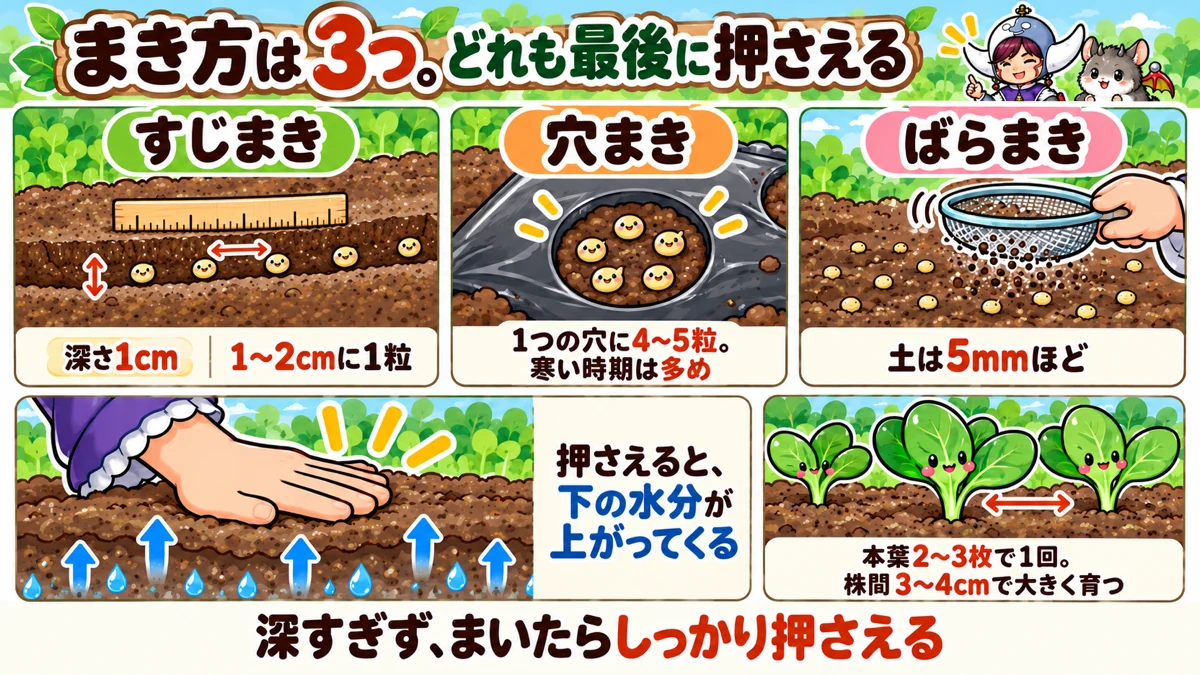
What this diagram says (図解の文字)
- Three ways to sow — and every one ends with firming
- "Drill": "1 cm deep", "one seed every 1–2 cm"
- "Station sowing": "4–5 seeds per hole; more in cold weather"
- "Broadcast": "about 5 mm of soil on top"
- "Firm it and moisture rises from below"
- "Thin once at 2–3 true leaves. 3–4 cm apart grows big plants"
- "Not too deep — and firm it well after sowing"
③ Sowing
Drills: the standard
- Make a straight drill about ½ in (1 cm) deep
- Place one seed every ½–¾ in (1–2 cm)
- Pull soil back over from the sides
- Firm it hard with your palm, then water
Spacing seeds one by one is fiddly, but if you just scatter them they come up in clumps, and thinning pulls up the neighbours too. With a gap of ½–¾ in, you just pull every other one. One tip: mark a strip of cardboard or a cane every ¾ in (2 cm) and sow along it.
Station sowing: through planting-hole mulch
Press a small hollow about ½ in (1 cm) deep (a bottle cap works), drop in 4–5 seeds, cover and firm. In spring, four seeds can all be grown on without thinning; in cold weather sow a few more, as germination is patchier.
Broadcasting: for small leaves
Scatter seed over a patch, sieve about ¼ in (5 mm) of soil over it, and press it down. You harvest the thinnings as you go — a method that suits winter especially (see ⑧).
Mulch by season
In winter, planting-hole mulch warms the soil and keeps weeds down. From spring on, many growers drop the mulch and sow in drills — mulch on warming soil can make it too hot.
Firming is what makes it germinate
Whatever the method, press the soil down firmly over the seed. It brings seed and soil into close contact so moisture reaches the seed, slows drying, and stops seed washing away when you water. One grower presses with almost their full weight.
④ Watering
- After sowing, water well — unless the soil is already damp, in which case you can skip it. Keep the surface from drying out until the seedlings are up
- Start and stop the watering can off the bed. The first and last gush comes out hard and can wash seeds away. Once it flows evenly, sweep along the row and back
- In winter, don't overdo it. Every watering chills the soil, and seeds need warmth to germinate. After a winter sowing, one watering is often all it needs — under mulch, almost none after that
- No seedlings yet? Don't add more water. In cold weather, germination takes a week to ten days. If nothing has appeared after about ten days, re-sowing gets you back on track faster than watering
- Fleece laid over the bed after sowing keeps the soil from drying, so you water less
- Once established, water in the ground only when it's dry and rain is scarce. Containers dry fast: water well whenever the surface is dry
⑤ Thinning and spacing
Thin once, when the plants have 2–3 true leaves, about 1½–2 in (4–5 cm) tall. Take out the weak, the leggy and the crowded first.
- Spacing decides the size. Leave about 1¼–1½ in (3–4 cm) and they grow large; leave them as sown and you get lots of small plants. Choose by what you want to eat
- Station-sown: keep 3–4 plants per hole. Five or more is too cramped
- Eat the thinnings — in soup, blanched, or scattered over salad. Think of thinning as your first harvest
- In a container filled with fresh, pre-fertilised compost, unthinned plants still grow to a reasonable size
⑥ Feeding and disease
It's a short crop. On ground with leftover fertiliser, most crops never need a top-up. Feed only if you sowed in a hurry without any, or the leaves are pale and growth has stalled — then a little between the plants, watered in.
More fertiliser is not better. Overfed plants grow soft and weak and catch disease more easily.
White rust
A common disease on komatsuna and turnips: pale, blurry spots on top of the leaf, raised white blisters underneath, then yellowing. Pick off affected leaves and take them off the plot — slipping a plastic bag over the leaf as you remove it stops the spores scattering. To prevent it:
- Don't overfeed
- Thin so air can move between the plants
- Harvest promptly so the bed doesn't get crowded
- Dig well for good drainage; on heavy ground, raise the bed
Resistant strains help, and solarising the soil over summer (see soil solarisation) can be expected to reduce it.
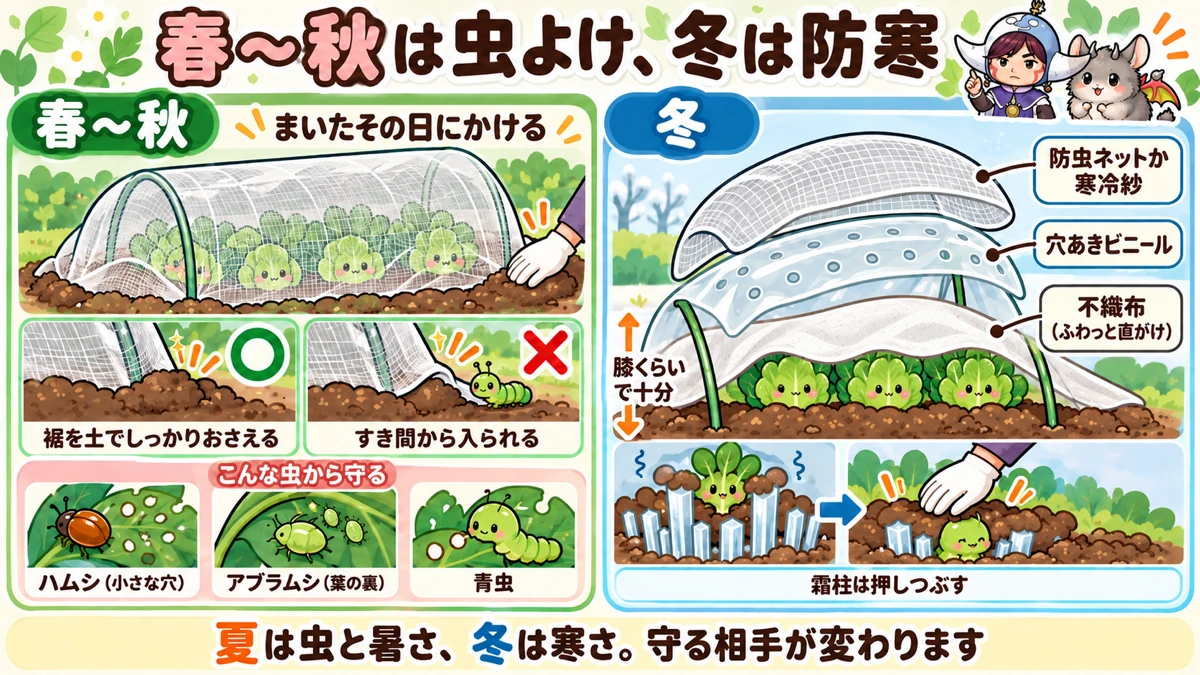
What this diagram says (図解の文字)
- Insects from spring to autumn, cold in winter
- "Spring to autumn" — "put it on the day you sow" / ◯ "bury the edges firmly in soil" / ✕ "they get in through gaps"
- "What you're protecting against": "flea beetles (small holes)", "aphids (under the leaves)", "cabbage caterpillars"
- "Winter" — top to bottom: "insect net or shade cloth", "perforated polythene", "fleece (laid loosely, straight on the crop)" / "knee height is plenty"
- "Press frost heave back down"
- "Summer means insects and heat; winter means cold. What you're guarding against changes"
⑦ Insects — and summer sowing
Among brassicas, komatsuna is a real insect favourite. Growing without sprays, this is the main challenge.
- Net it the day you sow, from spring to autumn. Put it on after the seedlings are up and something may already be inside. Bury or pin the edges so there are no gaps
- Flea beetles make lots of small holes — the commonest damage. In late winter they aren't active yet, which is why late-winter sowings come out so clean
- Aphids cluster under leaves and on new growth, more so in crowded beds. A few can be rubbed or washed off. One method: spray a mix of a little oil and soap in water, leave it ten minutes, then rinse the aphids off with a watering can
- Caterpillars eat large holes
Mixing in plants with a different scent — crown daisy, lettuce, garlic chives or carrots — may help keep insects off. None of these is a sure thing, but together with netting they're worth having. Komatsuna can also be sown between overwintering broad beans or peas: it grows about 1 ft (30 cm) tall and shelters the young bean plants from cold wind and frost.
Summer sowing
- Choose seed labelled heat-tolerant. Even sown in midsummer, it can be ready in about six weeks
- Don't let it dry out before germination — hot, dry soil won't germinate
- Shade the new seedlings. Use a light shade cloth — too much shade makes them leggy. Fleece left on a little longer works too
- Sow small amounts. In heat it all matures at once
- Or skip midsummer altogether, look after the soil, and sow again in autumn
⑧ Winter growing
Layer the covers
- Bottom: fleece laid loosely straight over the sown row — loose, not taut, so air moves and it doesn't get muggy
- Over that: a low tunnel of insect netting or perforated polythene
- Edges: pinned so the wind can't lift them
For the tunnel, knee height is plenty — komatsuna doesn't get tall. Use three hoops: angle the two end hoops slightly outward so the cover pulls tight, keep the middle one upright, and level all three before covering.
Why perforated polythene? Sealed solid polythene can let heat escape on clear nights so the inside gets colder by dawn than you'd expect. If unperforated is all you have, make a few holes. A net or white shade cloth over the polythene stops it blowing about and adds warmth; failing that, two layers of fleece.
Other winter points
- Late in the season, don't wait to add fertiliser. If you're starting in the last few weeks before the first frost, waiting two or three weeks after fertilising means sowing into colder and colder soil. Sow now and top-dress later if needed
- Frost heave lifts small plants and their roots dry out. Press the lifted soil back down by hand — through the mulch if need be
- Weed inside the tunnel. The warmth grows weeds too, and those at the base take the plants' food
- Keep the fleece on longer. In spring and summer it comes off 1–2 weeks after germination; in cold weather leave it until the plants are 4–8 in (10–20 cm) tall
- Very late sowings are tough. Once the deep cold sets in, even komatsuna struggles under a simple tunnel. Sow as early in winter as you can
- Watch where you sow. A late-winter sowing occupies the ground into late spring, so keep it out of beds meant for early summer crops
The winter no-thinning method
Normally you thin the slow ones and grow on the rest. In winter you can do the opposite: broadcast thickly in a sunny spot, don't thin, and pull the biggest plants first. Each time you pull one, the small ones around it grow on to fill the gap. In summer this crowding invites insects; in winter there are almost none, so the leaves stay clean. Sow evenly, sieve about ¼ in (5 mm) of soil over, and press it hard — no mulch needed.
⑨ Containers
- Fill with ordinary potting compost (no need for a layer of stones in a container with good drainage holes). Level it and tap the container so there are no gaps
- Make a ½ in (1 cm) drill along the long side and place a seed about every ½ in (1 cm). Cover and press gently
- Water until it runs out of the bottom. If seeds wash out, just push them back in
- Thin so the leaves don't overlap. At around two months and 4–6 in (10–15 cm), pull whole plants or cut outer leaves
- Komatsuna, turnips and spinach can share one container in separate rows if they're sown at the same time
⑩ Harvest — and flowers
Harvest about a month after sowing in warm weather, around 40 days in autumn, about two months in the cold, whenever it's a good size to eat. It grows fast, so in warm weather pick early rather than late. Pull whole plants, or cut above the base and let it regrow.
In spring it bolts — sends up a stem and buds. The leaves toughen, but the young buds are delicious as "nanohana"-style greens. Snap them off while they still break cleanly, just before they open. They have komatsuna's own slight bite, different from turnip or radish shoots.
⑪ Where growers disagree
- Sowing depth. Most say ½ in (1 cm). Others point out that a finger-poked hole easily ends up too deep, and prefer to press the soil flat, lay the seed on top and push it in lightly. Both agree: too deep is bad
- Thinning in winter. Some thin station-sown holes to 3–4 plants even in winter; others leave everything and harvest the biggest first, saying the crowd shelters itself from cold wind. Thin for bigger plants, leave for lots of small ones
- Base fertiliser. None where the last crop left some, some on fresh ground. Both are really asking the same question: is there fertiliser left in this soil?
⑫ Common problems
- Summer sowing didn't come up → check the seed, the watering and the shade
- Full of holes → no net, net put on too late, or gaps at the edges
- Winter sowing won't grow → cold. Fleece plus tunnel, allow longer, and pick small
- Too much at once → a packet holds a lot of seed. Sow little and often for a long harvest. Leftover seed can be mixed with other salad leaves and broadcast in a winter corner for baby leaves
Because it's so quick, one grower manages about five crops a year in the same spot. Avoid the depths of winter and summer and it fits in almost anywhere.
Science bit: why firming helps, and why winter komatsuna stays clean 🔬
Soil is full of tiny gaps. Press it down and the gaps get smaller — and water climbs up narrow gaps the way it climbs a thin tube (capillary action). Moisture from lower down rises to the surface and keeps the seed damp. Left fluffy, the gaps are too big for water to climb, and the surface dries out fast. The shallower the seed, the bigger the difference — which is why firming matters so much for komatsuna.
And winter's spotless leaves? The plant hasn't toughened up — the insects have slowed down. Most of komatsuna's pests are active in warm weather and sluggish in the cold. That's also why crowding is fine in winter and risky in summer.
To sum up
- ✅ Sow almost all year — autumn into winter is easiest
- ✅ Choose seed for the season: heat-tolerant in summer, cold-tolerant in winter
- ✅ Little or no base fertiliser where the last crop left some
- ✅ ½ in (1 cm) deep, one seed every ½–¾ in, then firm hard
- ✅ Thin once at 2–3 true leaves; wider spacing grows bigger plants
- ✅ Net it the day you sow, spring to autumn
- ✅ Winter: fleece plus a tunnel — or sow thickly and pull the biggest first
- ✅ Bolted? Eat the buds
Once you know where to put the effort each season, komatsuna is a crop you can grow again and again. Pick a packet that suits this season and sow a little 🥬
Thank you for reading!