Green beans 🫘 Pick them young and often

🫘 "My beans flower, but no pods form."
🫘 "The vines got so tangled I couldn't do anything with them."
🫘 "By the time I picked them, the pods were tough and stringy."
Hello, I'm Eiko. Eight years of growing vegetables organically and without pesticides, and a teaching licence in science.
Green beans are easy, productive and a favourite in home gardens. Boiled, stir-fried or dressed with sesame, they're delicious, and they brighten up a lunchbox. In Japan they're sometimes called sando-mame, "three-times beans", because if you stagger your sowings you can harvest them several times a year.
But I often hear "it flowers but there are no pods", "the vines got tangled beyond help", "they didn't come up" and "the pods went tough". This article goes through green beans step by step: choosing a type, sowing, netting, feeding, harvesting and the common mistakes.
Where you garden: this article follows central Japan, where beans are sown in April–May and picked in June–July, before the summer heat. Wherever you are, the rule is the same: green beans are frost-tender, so sow after your last spring frost, once the soil has warmed to about 60°F (16°C). They also dislike heat: above about 86°F (30°C), flowers drop and pods don't set.
Hot summers (roughly USDA zone 8 and warmer): sow as early as frost allows so the plants crop before midsummer, and sow again in late summer for an autumn crop. Cool summers (zone 6 and colder, and much of Britain): heat is rarely the problem — sow a little later, after the soil warms, and you can keep sowing into early summer.
The essentials: bush beans need no support; climbing beans need a 6½ ft (2 m) net; 3–4 seeds per hole, thinned to 2; lime acid soil; leave about three years before beans go back in the same spot; feed at flowering; pick young and often.
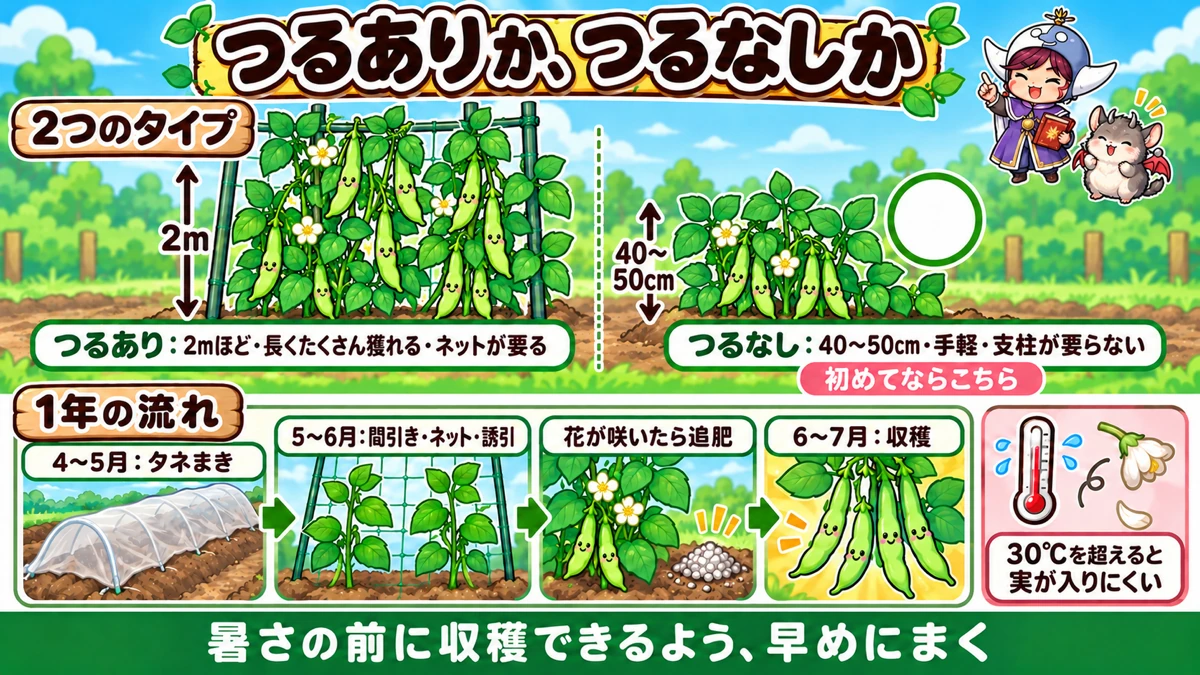
What this diagram says (図解の文字)
- Climbing or bush?
- "Two types": "Climbing: about 2 m, crops long and heavily, needs a net" / "Bush: 40–50 cm, easy, no supports — start with these"
- "The year": "April–May: sow" → "May–June: thin, net and train" → "Feed when they flower" → "June–July: harvest"
- "Above 30°C, pods don't set"
- "Sow early so you harvest before the heat"
① The quick version
Timing (central Japan)
- Sowing: April–May. Bush beans until early June
- Summer sowing: sow in July–August for an autumn crop (depends on area and variety)
- Harvest: bush beans about two months after sowing; climbing beans crop for longer
Numbers to remember
- Spacing: about 12 in (30 cm)
- Sowing depth: about ¾ in (2 cm)
- Seeds per hole: 3–4, thinned to 2
- Height: climbing beans about 6½ ft (2 m); bush beans 16–20 in (40–50 cm)
- Rotation: leave about three years
What matters most
- Dislikes acid soil — adjust with lime
- Dislikes wet — good drainage
- Dislikes heat — pods set poorly above 86°F (30°C)
- Pick the pods young
② About green beans
Beans for pods, beans for drying
The green beans we eat as a vegetable are young pods, picked before the beans inside have grown. Other beans of the same species are grown on until the beans mature, then harvested dry — kidney beans, borlotti, cannellini, and Japan's kintoki red beans among them. The difference is mainly when you harvest. This article focuses on green beans grown for their pods.
Climbing and bush
- Climbing (pole) beans: vines grow to about 6½ ft (2 m) and need supports or a net. They crop for longer and more heavily
- Bush (dwarf) beans: 16–20 in (40–50 cm) tall, no supports needed, easy. Shorter harvest, smaller total crop
Choose bush beans for ease, climbing beans for a long, heavy harvest. In containers on a balcony or in a small space, bush beans suit best.
They don't like heat
Green beans originally prefer a cool climate — one reason dry beans are grown in quantity in cool Hokkaido. When it gets above about 86°F (30°C), flowers open but pods don't set, and more flowers drop. So the basic plan is to sow early in spring and harvest before the real heat arrives.
③ Choosing a type
Starting out? Bush beans
No supports or nets to set up, and simple to look after — bush beans are the place to start. They're ready about two months after sowing, so you see results quickly too.
Want lots? Climbing beans
Climbing beans take a bit of work to net, but they keep flowering as the vines grow, so the harvest runs longer and the total is bigger.
Pod shapes
There are slim, round-podded beans and broad, flat-podded types (like Romano beans). Choose by how you like to eat them.
Cheap seed grows fine
For a few plants in a home garden, a small packet is plenty. Check that the packet gives the variety name, sowing time and days to harvest.
Use fresh seed
Bean seed is relatively short-lived and germinates poorly when old. Rather than using last year's or the year before's, buy seed each year and use it up that year. Sharing leftovers with friends is a good way to do it.
④ Where to grow, and the soil
Dislikes acid soil
Beans struggle in acid soil, where roots grow poorly. At least two weeks before sowing, add lime to correct acidity.
Dislikes following itself
Growing beans or other legumes in the same spot year after year leads to poor growth. Leave about three years before beans go back where they grew.
Dislikes wet
In poorly drained ground, roots rot easily and disease takes hold. Choose a well-drained spot, or raise the bed.
Go easy on fertiliser
Legumes can use nitrogen from the air, thanks to bacteria living in nodules on their roots. So they need little fertiliser, especially nitrogen — keep base fertiliser lighter than for other crops.
But green beans grow fast, and the nodule bacteria can't always keep up. A common approach is a light base dressing, then a top-up feed when they flower.
- Two weeks before sowing, dig in lime and a modest amount of compost or organic fertiliser
- Make the bed and lay mulch film
Getting ready, step by step
- About three weeks before sowing: choose the spot; check no legumes grew there in the last three years or so
- About two weeks before: spread lime and dig it in, with a modest amount of compost or organic fertiliser
- About a week before: make the bed and lay mulch; for climbing beans, gather canes and netting
- Sowing day: have fleece ready to cover the sowing straight away
Buy seed or plants once the ground is ready and you won't be rushing.
⑤ Sowing
Sowing direct
- Make holes about ¾ in (2 cm) deep, 12 in (30 cm) apart.
- Put 3–4 seeds in each hole. Bean seeds are elongated — lay them on their sides.
- Fill the hole with the surrounding soil and firm it gently by hand.
- Water well.
- Cover with fleece so birds can't eat the seeds or shoots.
Some bought seed is coloured with a fungicide coating. Wash your hands after handling it.
Raising plants in pots
Where birds are a problem, or to get an early start, you can sow in pots and plant out.
- Fill a 3½ in (9 cm) pot with compost, lay 2–3 seeds on their sides and cover with about ½ in (1 cm) of soil.
- Water well.
- In warm weather no extra heat is needed. Keep the compost from drying out.
- They come up in about a week.
- Plant out as the first true leaves appear.
If they don't come up
- Sown too cold: beans hate cold. Wait until it's warm
- Old seed: use fresh
- Too wet, so the seed rotted: don't keep the soil soaked after sowing
- Sown too deep: about ¾ in (2 cm) is right
- Eaten by birds or slugs: cover with fleece after sowing, and check for slugs at night as they come up
Buying plants
- Choose young plants with 2–3 true leaves; overgrown ones root in poorly
- Choose dark leaves and a sturdy stem
- Check under the leaves for insects
- Plant without breaking up the root ball; beans dislike root disturbance
Thinning
When plants have 3–4 true leaves, keep two per hole and remove the rest. Roots may be tangled, so rather than pulling, snip the extras off at soil level with scissors to protect the roots of the ones you keep.
Earthing up
If sowing was shallow or thinning lifted the soil and roots show, draw soil up round the base to steady the plants. Beans grow poorly when roots dry out or are exposed.
Watering after sowing
Bean seeds rot if they take up too much water. Water well at sowing, then until they come up, water only lightly when the surface dries. Daily soakings can spoil the seed. Fleece helps stop the soil drying out too fast.
Once the seedlings are up and the seed leaves open, remove the fleece. Left on, it makes the seedlings stretch and go leggy.
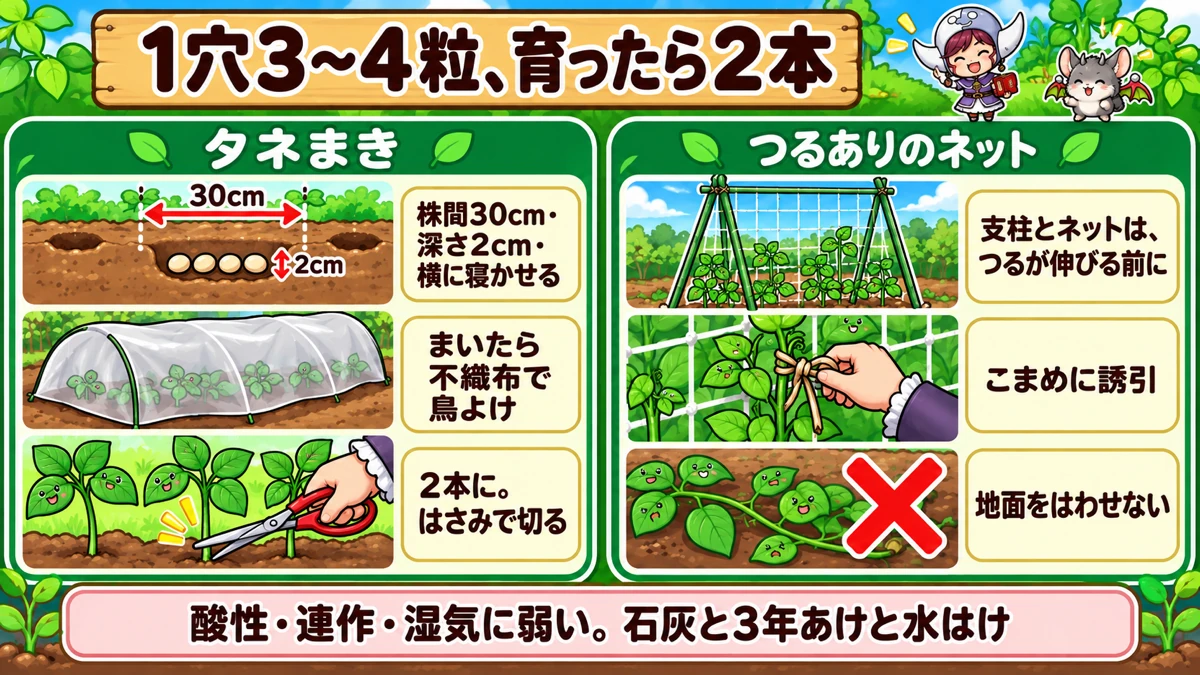
What this diagram says (図解の文字)
- 3–4 seeds per hole, keep 2
- "Sowing": "30 cm apart, 2 cm deep, seeds on their sides" / "Cover with fleece against birds" / "Thin to 2 — cut with scissors"
- "Netting for climbing beans": "Canes and net before the vines run" / "Train them often" / "Don't let them sprawl on the ground"
- "Dislikes acid soil, repeat planting and wet. Lime, a three-year gap, good drainage"
⑥ Supports and netting (climbing beans)
Get them ready as soon as they come up
Climbing beans start sending out vines almost as soon as their true leaves grow. Have the canes and net up before the vines start to run.
One way to put up a net
- Push 6½ ft (2 m) canes in along both sides of the row and cross them at the top (an A-frame).
- Lay a cane along the crossing points and tie it in.
- Hang a climbing-plant net (a cucumber net is fine) over the frame.
- Clip or tie the edges of the net to the canes.
There are other ways, such as netting stretched between upright canes. Push the canes in deep so wind can't topple them.
Training
Guide the growing vines onto the net. Until they wind round it by themselves, tie them loosely to the canes or net.
Leave them be and the vines sprawl over the ground in every direction, tangle together and become unmanageable — and with no air moving through, disease spreads. As soon as the vines start, guide them onto the net, little and often.
Net height and direction
A 6½ ft (2 m) net gives climbing beans room to grow. If it's above your reach, picking gets awkward; if the vines get too tall, pinch out the tips or run them sideways along the top.
Ideally run the row north–south so both sides of the net get sun. In an east–west row where the north side is shaded, plant beans on the south side and something shade-tolerant to the north.
Bush beans need no support
Bush beans are short and generally need no canes or net. In windy spots, earth up the base so they don't flop.
Stopping the tips
When climbing beans reach the top of the net, pinch out the tips. This sends energy to the lower branches, helps side shoots flower, and stops a tangled, airless mass forming on top.
⑦ Feeding and watering
Feed when they flower
Give the first top-up feed as flowering begins. Beans grow fast, and once flowers and pods form they need plenty of nutrients.
- Scatter a little fertiliser a short way from the stem and mix it lightly into the soil
- For climbing beans, feed every 2–3 weeks while the harvest continues
- Too much nitrogen gives lots of leaf and vine and few flowers or pods
Watering
Beans dislike wet soil, but if the soil dries right out while they flower and set pods, flowers drop and pods curl.
- Normally, water when the surface is dry
- If rain is scarce while they flower and set pods, water generously in the morning
- Don't overwater poorly drained ground
⑧ Harvesting
How to pick
- Go out in the cool of the morning with scissors and a basket
- Working up from the bottom, part the leaves to find pods — they're the same colour as the leaves and easy to miss
- Snip ready pods off at the stalk
- Pick any that have grown too big as well, so the plant doesn't tire
- Don't tug the vines — you'll damage tips and flowers
Pick them young
Green beans are best while the pods are young and the beans inside don't yet show. Pods reach picking length about 10–15 days after flowering.
- Once the beans bulge visibly through the pod, the pod turns tough and stringy
- Cut at the stalk with scissors; pulling by hand can damage vines and flowers
The more you pick, the longer they crop
Leave pods too long and the beans inside start to grow; the plant puts its energy into them and makes fewer new flowers. Pick young and often, and new flowers keep coming and the harvest goes on. Once picking starts, check every 2–3 days.
Harvesting dry beans
Varieties grown for dry beans are harvested when the pods have turned yellow and withered and the beans inside are hard and dry. It takes longer than for green pods, and heat during flowering stops beans setting, so early sowing matters even more.
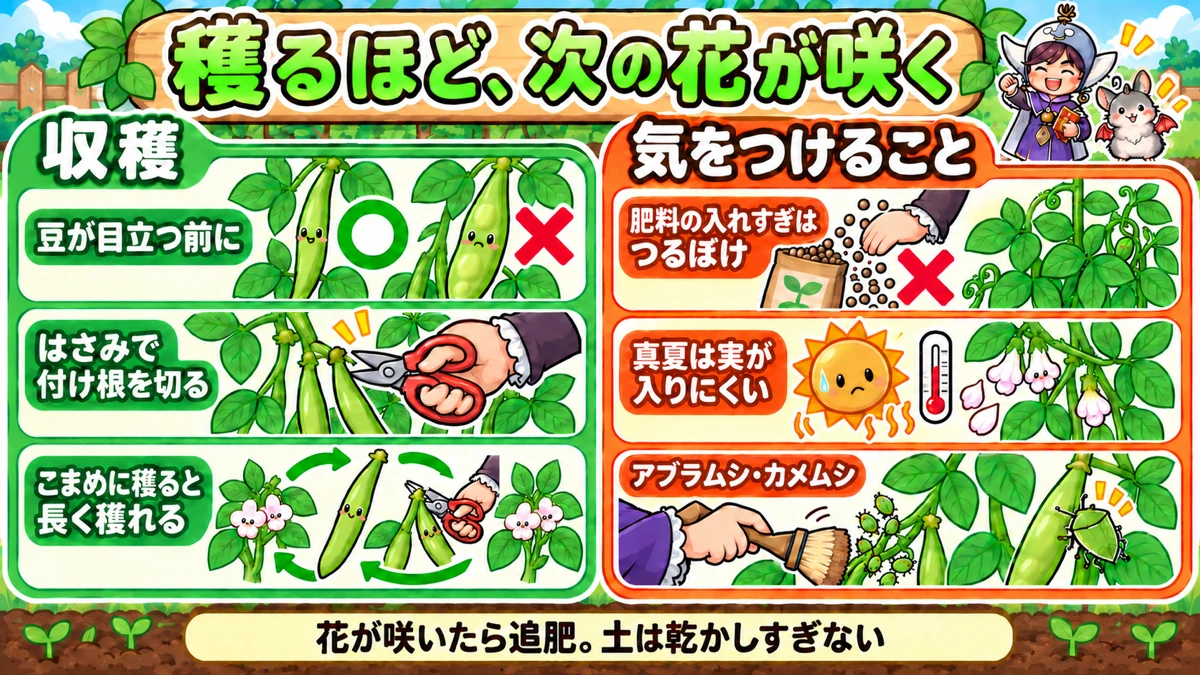
What this diagram says (図解の文字)
- The more you pick, the more they flower
- "Harvest": "Before the beans show" / "Cut at the stalk with scissors" / "Pick often and they crop for longer"
- "Watch out for": "Too much fertiliser = all leaf" / "In high summer, pods don't set" / "Aphids and stink bugs"
- "Feed when they flower. Don't let the soil dry out"
⑨ In the rainy season
In Japan, flowering and the first pickings coincide with the early-summer rains. Wherever you are, a wet spell at flowering brings the same problems.
- Damp weather encourages disease; remove old lower leaves so air moves round the base
- After rain, check the vines haven't fallen or come off the net
- Cover the soil with mulch or straw to stop soil splashing up
- Pick on dry days between showers; wet pods spoil fast in storage
In dry spells, or on unmulched ground, the soil may instead get too dry as pods form. Scratch into the soil by the stem; if it's dry, water.
⑩ Summer sowing for an autumn crop
Sow in early summer, pick in autumn
Beans can also be sown in summer for an autumn harvest. For example, a variety that's ready about 65 days after sowing, sown in late June here, crops in September–October as the heat eases. The idea is that new plants take over just as the spring beans stop setting in the heat. Work back from your own first autumn frost: you need roughly 9–10 weeks for bush beans to crop before it.
Softening the heat
- Use shade netting or light shade cloth to soften direct sun
- Water in the morning after sowing so the soil doesn't dry out
- Mulch with straw so the soil at the base doesn't overheat
Take over the cucumber net
Another trick: sow climbing beans near the base of cucumbers or squash that will finish at the end of summer, then let the beans take over the canes and net as the cucumbers die back. No need to put up new supports, and the bed keeps working. Do check that no cucurbit diseases or pests are lingering there.
⑪ Growing beans to dry
Kidney beans and friends
Kidney beans and other beans for cooking are the same species. You can even sow beans sold dry for the kitchen (not all of them will germinate).
Sow early
For dry beans, it takes about three months from sowing until the pods wither and the beans mature. Flowers that open in high summer set few beans, so sow early enough to harvest before the hottest weather — here, mid to late March.
- For early sowings in cool weather, lay fleece over the soil and cover with a perforated plastic tunnel for warmth
- Use a raised, well-drained bed with black mulch film
- To dodge summer heat, a spot in light afternoon shade can help
Hardly any fertiliser
In soil that has grown other vegetables, you can start without fertiliser. If the soil is very poor, scatter a little organic fertiliser and a pinch of wood ash round the plants.
Harvesting and drying
When the pods turn from yellow to brown and the beans rattle inside when shaken, harvest. On a dry day, pull the whole plants or pick the pods, dry them further somewhere airy, out of the rain, then shell the beans.
⑫ Clearing up
- Pull plants up roots and all. Small beads on the roots are nodules, home to the nitrogen-fixing bacteria — not a disease
- If vines are wound into the net, cut them at the base and let them dry before untangling — much easier
- Take diseased plants off the plot; healthy ones can be chopped and composted
- Clean and dry nets and canes before storing
After beans, a little nitrogen may remain in the soil from the root nodules. Follow with leafy greens or another non-legume.
⑬ Pests and diseases
What to check, stage by stage
- As they come up: bird or slug damage
- As the vines start: aphids on the tips; vines trained onto the net
- At flowering: flowers dropping; soil too dry
- As pods form: stink bugs; overlooked old pods
Aphids
Aphids can gather on new seedlings and vine tips. The tips are thin and snap easily, so don't try to squash them by hand — brush them off or wash them off with water.
Slugs and birds
Freshly sown seed and new seedlings are prime targets. Cover with fleece, and as they come up, check for slugs after dark.
Stink bugs
From pod set, stink bugs may suck the pods, which turn blotchy or crooked. Shake the plants morning and evening and catch what drops.
Grasshoppers
Grasshoppers may eat young leaves. Catch them while they're small.
Spider mites
In hot, dry weather, tiny mites feed under the leaves and pale, speckled patches spread over the upper surface. Spraying water under the leaves reduces them; in long dry spells, check the undersides carefully.
Disease
- Train vines so leaves don't crowd
- Remove old and yellowing lower leaves
- Grow in well-drained soil
⑭ Successions and companions
Stagger your sowings
Beans go from sowing to harvest fairly quickly. Sow a few at a time every 2–3 weeks and the harvests won't all come at once — fresh beans over a long season, and no glut you can't eat.
Bush beans fit in anywhere
Short bush beans slot in between other crops, a good way to use limited space. Combinations with aubergines, sweet potatoes and sweetcorn are often suggested.
Climbing beans and sweetcorn
There's the old pairing of climbing beans sown at the foot of sweetcorn, using the corn as a support. Stagger the sowing so the beans don't smother the corn.
With aubergines and peppers
Bush beans planted between aubergines or peppers are said to enrich the soil a little through their root bacteria, and their leaves shade the soil and keep it from drying out. Leave enough room, though, or both lose light and air.
⑮ Containers
- Bush beans suit containers best
- A planter at least 8 in (20 cm) deep and 24 in (60 cm) long takes 2–3 sowing spots
- Sow 3–4 seeds per spot and thin to 2
- With vegetable compost, lime and base fertiliser usually aren't needed
- Water when the surface is dry; don't let it dry out at flowering
- Give a little feed when they flower
⑯ Through the year (central Japan)
- March–April: choose the spot; dig in lime and compost; check it isn't a repeat planting
- April–May: sow; cover against birds; set up canes and net for climbing beans
- May–June: thin, earth up and train; watch for aphids; feed at flowering
- June–July: harvest young pods every 2–3 days; pods set poorly as heat builds
- July–August: for an autumn crop, sow so flowering falls after the worst heat
- September–October: pick the autumn beans; clear up
⑰ A bean that looks similar
Yardlong beans (asparagus beans) are a different species, but you eat their long pods in much the same way and the flavour is close. Their skin is thin and tender. They love heat and grow well in high summer, so in hot regions they're a good choice for a summer pod bean.
⑱ Where growers disagree, and common mistakes
Do they need feeding? One view says legumes need no fertiliser; another says green beans grow so fast they need a feed at flowering. Most advice agrees on a light base dressing, then deciding on a top-up by how the plants look at flowering. In newly dug ground with few nodule bacteria, leaves tend to go pale — top up there.
After another crop, is fertiliser needed at all? Some say that where other vegetables grew before, you need neither base nor top-up feed, and plants growing well need none. Too much nitrogen makes beans run to leaf and vine with few pods. Others recommend feeding at flowering. Decide by the plants: pale yellow-green leaves and weak growth — feed; dark leaves and vigorous vines — hold off.
Is summer sowing possible? Some say beans dislike heat too much; others say sow in high summer so they flower as it cools, for an autumn crop. Some advise avoiding climbing beans in summer. Plan so flowering doesn't fall in the hottest weeks.
Direct or in pots? Direct sowing is usual, but pots help where birds are bad or to get an early start in a cool spring.
Common mistakes:
- Flowers but no pods — heat above 86°F (30°C), dry soil, or too much nitrogen. Sow earlier, don't let the soil dry at flowering, and don't overfeed
- Vines tangled beyond help — train them onto the net as soon as they start; don't let them sprawl
- Tough, stringy pods — picked too late. Pick before the beans show
- They didn't come up — too cold, old seed, too wet, too deep, birds or slugs
- Same spot every year — growth suffers. Leave about three years
⑲ Questions people ask
The leaves are pale and growth is poor. In newly dug ground, or soil that hasn't grown legumes for a while, nodule bacteria are scarce, nitrogen runs short and leaves pale. Give a small top-up feed a little way from the stem. Acid soil can also be the cause, so lime before next time.
Can I grow climbing beans on a balcony? On a sunny balcony, yes — in a deep, large container with canes, and nets or strings for the vines. But vines reach about 6½ ft (2 m) and can rise above the railing and catch the wind. Fix the canes firmly and check the height first.
Why do the flowers drop? Heat, dry soil, too much fertiliser or too little sun. Plants also shed flowers they can't turn into pods. If heat is the cause, pods often start setting again when it cools.
Are green beans and yardlong beans the same? No — different species. You eat the pods of both, but yardlong beans love heat and grow well in summer. In hot regions they're a good summer alternative.
How much does one plant give? It depends on variety and care, but climbing beans crop longer and more heavily than bush beans. Picking young pods often increases the total.
What can I use instead of canes? Besides garden netting, strings stretched top to bottom work. You can reuse a cucumber or bitter gourd net as those crops finish. Vines grow to 6½ ft (2 m) and get heavy with pods, so fix the supports firmly.
My pods are curling. Dry soil at flowering, running out of food, or stink bugs sucking the pods. Check the plants and look for insects. Curled pods are fine to eat.
The leaves have gone mottled yellow. If leaves show a patchy pattern of dark and light green and new leaves crinkle, it may be a virus spread by aphids. There's no cure; pull the plant early and take it off the plot so it doesn't spread. Keeping aphids off from the seedling stage is the prevention.
How should I store them? Bag them so they don't dry out, keep them in the fridge's vegetable drawer and eat them soon. For a big harvest, blanch briefly and freeze.
What should follow beans? Leafy greens or another non-legume — a little nitrogen may be left from the root nodules.
Do I need lots of plants? It depends on your household, but beans keep coming, so a few plants can give plenty. With bush beans, small sowings spread out over time beat one big sowing you can't keep up with.
Science bit: five whys 🔬
Why don't pods set in the heat? For a flower to become a pod, pollen has to reach the stigma and the seeds then have to grow. When it's too hot, the pollen stops working properly, or the young pod fails to grow and the flower drops. When people say green beans dislike heat, it's mainly this "flower to pod" step that suffers.
Why lay the seed on its side? A bean seed has a "scar" (the hilum) in the middle of one flat side, near where the root and shoot emerge. Laid on its side, the root can head down and the shoot up naturally. A bean seedling pushes its seed leaves up through the soil as it emerges, so sown too deep, it can't lift the soil and fails to come up — hence the shallow ¾ in (2 cm).
Why don't they like acid soil? The nodule bacteria on legume roots turn nitrogen from the air into a form the plant can use. These bacteria don't work well in strongly acid soil. Without their help, beans grow poorly. Liming is partly about making a home where the bacteria can work.
Why does picking often keep them cropping? Plants flower to leave offspring, ripening seeds inside the fruit. Leave pods on and the beans inside mature; the plant, as if it has done its job, slows down on new flowers. Keep picking young pods and the plant keeps flowering, still trying to set seed. That's why frequent picking means a longer harvest.
Why do the vines wind round things? The tip of a climbing bean vine slowly circles as it grows, and when it touches something, it winds round it. Using whatever is nearby as a support, it climbs to spread its leaves higher and catch more light. Guide it onto a net and it winds its own way up.
To sum up
- ✅ Starting out? Bush beans. For a long, heavy harvest, climbing beans (they need canes and a net)
- ✅ Sow after the last frost, early enough to crop before the heat
- ✅ Dislikes acid soil, repeat planting and wet: lime, a three-year gap, good drainage
- ✅ 3–4 seeds per hole, 12 in (30 cm) apart, ¾ in (2 cm) deep; fleece against birds
- ✅ Thin to 2 at 3–4 true leaves — snip, don't pull
- ✅ Net climbing beans before the vines run, and train them often
- ✅ Feed at flowering; don't overdo it
- ✅ Don't let the soil dry out at flowering
- ✅ Pick young, with scissors. The more you pick, the longer they crop
- ✅ Use fresh seed
- ✅ A late-summer sowing gives an autumn crop; for dry beans, sow very early
- ✅ Sow a few every 2–3 weeks for fresh beans over a long season
With a few simple habits, green beans reward you with pod after pod. Plan so they crop before the heat, don't overfeed, and pick young and often — remember those three and you'll have plenty. Start in spring with a row of bush beans, 3–4 seeds to a hole 🫘
Thank you for reading!