Garlic chives: plant once, cut for three years 🌿 Planting, cutting, flower stems, winter and dividing
🌿 "I hardly got anything the first year."
🌿 "The leaves get thinner every year."
🌿 "Once it flowered, the leaves went tough."
Hello, I'm Eiko. Eight years of growing vegetables organically and without pesticides, and a teaching licence in science.
Garlic chives (Chinese chives, "nira" in Japanese) have flat leaves with a gentle garlic flavour. A handful lifts a stir-fry, dumplings or miso soup — and once planted, you can cut them again and again for years.
The catch is that, unlike most vegetables, this is a plant you live with for several years. This article follows the whole cycle: starting, planting, cutting, flower stems, winter, and dividing.
How to use this article. I garden in central Japan, roughly USDA zone 8b–9a. Garlic chives are very hardy perennials; the tops die back in winter and the roots carry on.
Basics. From seed, harvests start in the second year; from plants, two or three months after planting. Plant 3–4 shoots together, about 8 in (20 cm) apart. Cut at about 8 in (20 cm), leaving 1–2 in (3–5 cm). Divide about every three years.
① The year of a garlic chive clump
- Spring: new shoots appear. Plant clumps by early spring
- Early summer to autumn: cutting season — cut when the leaves reach about 8 in (20 cm)
- Late summer to autumn: flower stems appear. Pinch them out early
- Early winter: the leaves die back from the tips. Last cut
- Winter: the tops are gone and the roots rest. Feed now
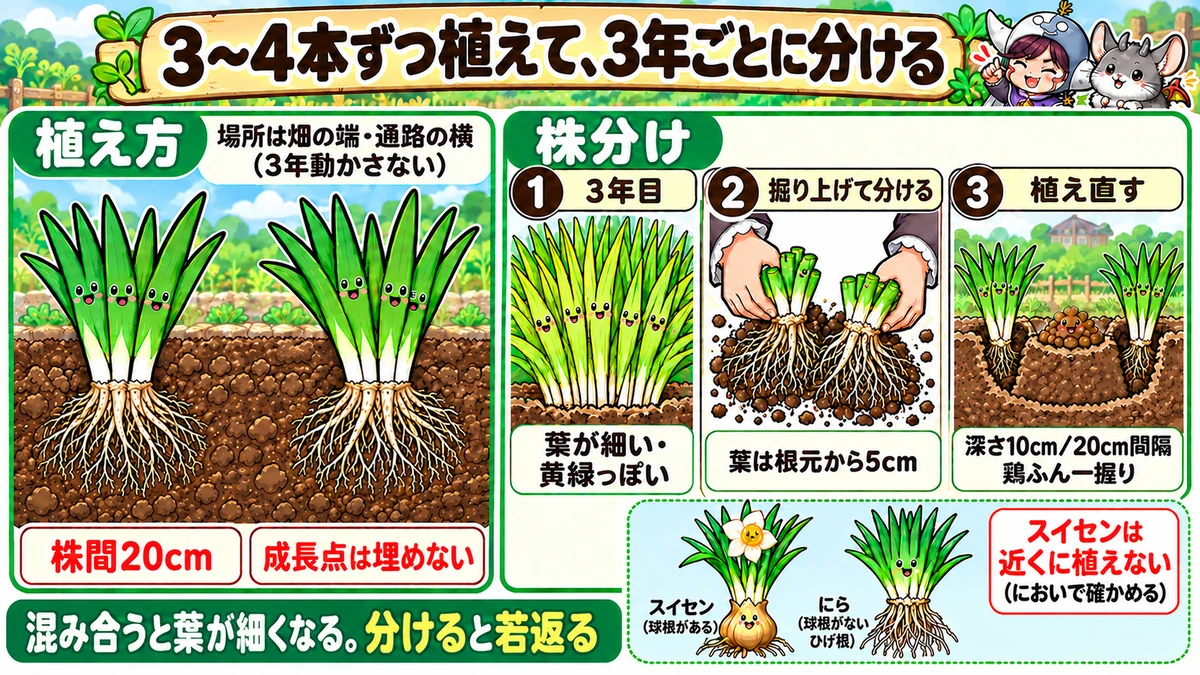
What this diagram says (図解の文字)
- Plant 3–4 together, divide every three years
- "Planting" — "at the edge of the plot or beside a path (somewhere you won't move it for 3 years)" / "20 cm apart" / "don't bury the point where the leaves divide"
- "Dividing" — "① third year: thin, yellow-green leaves" → "② dig up and split: leaves cut to 5 cm from the base" → "③ replant: 10 cm deep, 20 cm apart, a handful of chicken manure"
- "Daffodil (has a bulb)" vs "garlic chives (no bulb, fibrous roots)" — "don't plant daffodils nearby (check by smell)"
- "Crowded clumps grow thin leaves. Dividing rejuvenates them"
② Getting started
- From seed: sow in early spring; the seedlings are big enough to plant out after about three months. But you barely harvest that first year — let the plants build up and start cutting in year two. An autumn sowing also works, but the first cut still comes the following summer, nearly a year later
- From plants: the quick route — cutting begins two or three months after planting. Garden centres sell them in spring, including year-old clumps lifted from the ground
- From a friend: garlic chives multiply so readily that growers who divide them every few years usually have spare clumps to give away
Choose the biggest plants you can. A small plant only makes small leaves that first year — and picking those starves the roots. With garlic chives, unlike summer vegetables, a pot packed with white roots is fine.
Plant early in spring — from just before to just after the last frost, so it gets a long run of gentle sunshine to build roots. Some growers prefer late winter, while it's dormant: clumps planted then send up new shoots by early summer and can be cut from midsummer.
③ Where to plant, and the soil
Choose a spot you won't need to move it from for three years — the edge of the plot, beside a path, along a fence. In the middle of a bed it gets in the way of every year's planting. Garlic chives aren't fussy about position.
- Feed "for three years". They're hungry plants staying put for years. One example rate: about 2 litres of composted cow manure and 150 ml of chicken manure per square metre, mixed evenly so growth is even
- They dislike acid soil. Add lime if yours is acidic
- Dig deep — they root deeply — and wait 2–3 weeks after adding fertiliser before planting
- Mulch film is optional, and can get in the way over several years. Many growers plant without it
④ Planting
- Plant 3–4 shoots together in each spot. They're said to grow better in company
- About 8 in (20 cm) apart is enough. Through black mulch, one clump per hole at 6 in (15 cm), or two per hole at 1 ft (30 cm)
- For two rows: 8–10 in (20–25 cm) between clumps, about 1 ft (30 cm) between rows
- Depth: cover the white base of the leaves, but keep the point where the leaves divide above the soil (the growing point itself sits lower, at the base)
- Long leaves can be trimmed before planting. Trimming over-long roots a little encourages fresh ones
- Water deeply on planting day so it soaks right down to the deep roots. If it's cold, cover with fleece until established
And in the year you plant, don't over-pick. Cut the young leaves and the roots never fill out — that year and the next both suffer.
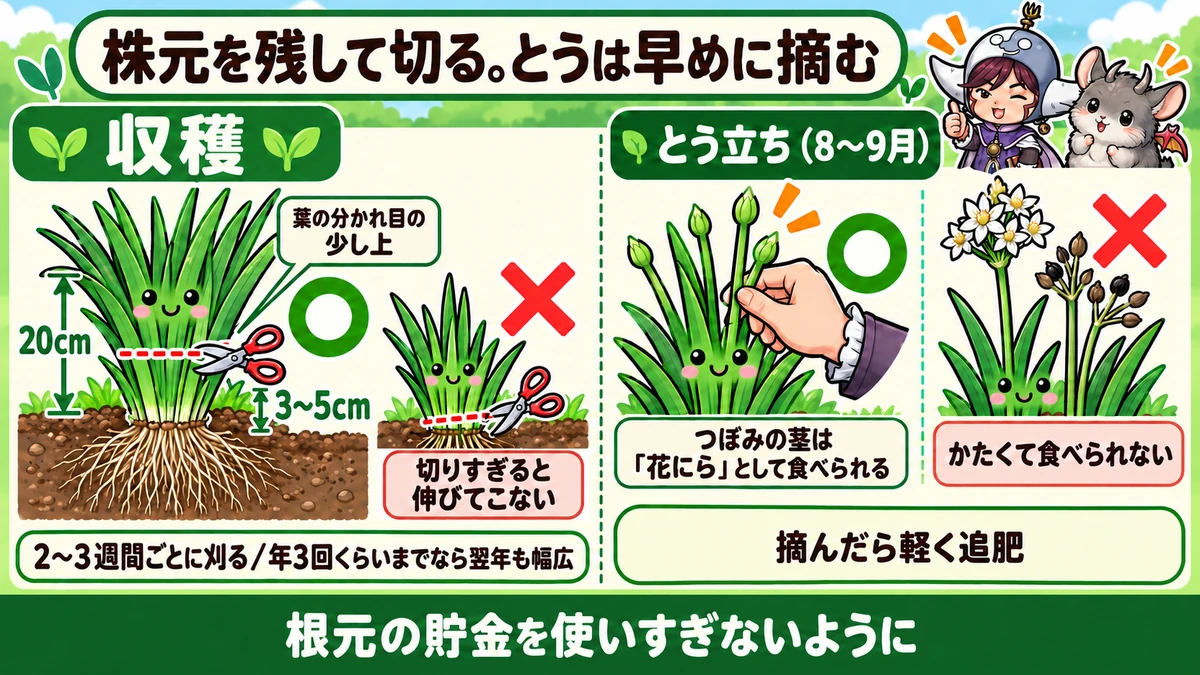
What this diagram says (図解の文字)
- Cut leaving the base. Pinch out flower stems early
- "Harvest" — "20 cm" / "a little above where the leaves divide" / "3–5 cm" ◯ / ✕ "cut too low and it won't regrow"
- "Cut every 2–3 weeks / up to about three cuts a year keeps next year's leaves broad"
- "Flower stems (Aug–Sep, central Japan)" — ◯ "budded stems can be eaten as 'flowering chives'" / ✕ "tough and inedible" once flowered and seeding
- "Feed lightly after pinching"
- "Don't overspend the savings at the base"
⑤ Cutting
Cut when the leaves are about 8 in (20 cm) long. Left longer, they toughen and lose flavour — timing really matters with this crop.
- Use scissors, don't pull. Cut a little above where the leaves divide, leaving 1–2 in (3–5 cm). As long as the base and roots remain, new leaves come
- Don't cut too low. Right down at the base, new leaves may not come and the clump can die. Leave at least ¾–1¼ in (2–3 cm)
- Cut every 2–3 weeks to keep the leaves tender. After cutting, they're ready again in two weeks to a month, right through to winter
- The first spring leaves are often tough. Many growers cut them and let the next lot grow
- Autumn is the best season. When the late-summer flower stems are pinched and the leaves cut back at the same time, fresh growth starts in early autumn and the finest leaves of the year arrive in mid-autumn
How many cuts? Four or five a year is possible, but cutting too often drains the roots and next year's leaves come thin. For broad leaves next year, stop at about three.
After harvest, peel off any discoloured outer leaves — it cleans up the muddy base too and saves washing.
Feeding
Repeated cutting tires the clump. About once a month, a pinch of fertiliser a little away from the base, covered with soil (watered in if dry). Too much makes the leaves harsh and invites pests and disease: make a shallow groove about ½ in (1 cm) deep, about 4 in (10 cm) from the base, sprinkle it there and cover. Loosening the soil lightly 8–12 in (20–30 cm) out helps the spreading roots breathe.
⑥ Flower stems
From late summer into autumn, garlic chives send up flower stems. Once they do, the clump spends its food on flowers and seed — the leaves toughen and lose flavour. They're triggered after a certain amount of light and warmth from spring onward.
- Pinch them out as soon as you see them. If the clump is still small, take just the stems; if it's ready to cut, cut the whole lot leaving ¾–1¼ in (2–3 cm)
- Feed lightly afterwards so the food goes back to the leaves, and keep cutting regularly
- Some growers simply cut the whole clump back once the flowers start, then feed — fresh leaves follow
Don't throw the stems away. Budded stems are sold as "flowering chives" — crunchy and delicious. Once the flowers have been open a while the stems turn stringy, so pick in bud. The open flowers themselves are edible too, in tempura or dressed dishes.
After flowering, black seed forms and can be sown — but if you want good leaves from the same clump next year, don't let it set seed.
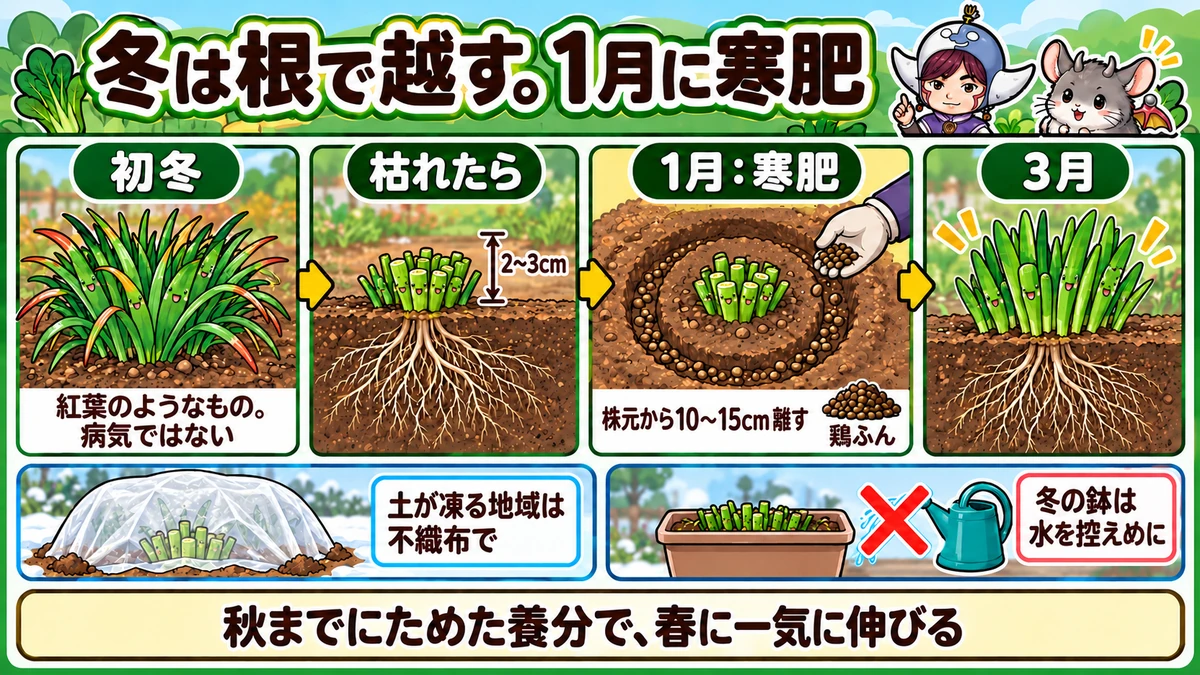
What this diagram says (図解の文字)
- It overwinters as roots. Feed in January (midwinter)
- "Early winter": "like autumn colour — not disease" → "Once it dies back": "2–3 cm" → "January: winter feed": "10–15 cm from the base", "chicken manure" → "March": new growth
- "Where the ground freezes, cover with fleece"
- "Go easy on water for pots in winter"
- "It shoots up in spring on what it stored by autumn"
⑦ Winter
Before winter, look at each clump. If the leaves are small, tough or slow, stop cutting and let them grow on until they die back — that refills the roots. Another option is to divide in autumn while it's still warm, so the divisions settle in for spring.
Garlic chives are hardy, but the tops die back once it's regularly below about 41°F (5°C), reddening from the tips like autumn leaves. That's normal, not disease. The roots live on, using what the leaves stored to shoot up in spring.
- Once fully withered, cut down to ¾–1¼ in (2–3 cm). New shoots come on their own in early spring
- Where the ground freezes solid, lay fleece loosely over the clump from early winter, pinned and weighted with soil. Fallen leaves work too. Rebuild any soil washed away from the base. Under mulch film, no fleece needed
The midwinter feed
- Dig a ring-shaped groove about 1 in (3 cm) deep, 4–6 in (10–15 cm) from the base
- Scatter about two handfuls of chicken manure in it (another grower uses one heaped tablespoon per clump)
- Cover with soil; water if dry; straw or fleece on top
Timing matters: chicken manure put down in midwinter breaks down over the following weeks and starts working in early spring — just as the clump starts growing in earnest.
Containers
A container 4–6 in (10–15 cm) deep is enough — handy for spare divisions. Winter care is the same, but go easy on water: soggy compost in winter is the main risk.
⑧ Dividing every three years
Over the years the clumps multiply and the roots tangle. They compete for food, and the leaves get narrower and yellowish. So after about three years, dig them up, split them and replant. Keep doing this and garlic chives go on more or less forever.
When: growers variously say winter dormancy, early spring after the worst cold, or autumn. Avoid the very coldest and the very hottest weeks and they'll settle in.
- Dig up with plenty of soil, cutting as few roots as you can, then shake the soil off
- Trim the leaves to about 2 in (5 cm)
- Pull the clump apart into groups of 3–4 shoots; don't force bits that won't separate. They're tough — a few broken roots don't matter
- Dig a trench about 4 in (10 cm) deep, set 2–3 groups about 8 in (20 cm) apart
- Put a handful of chicken manure between the groups and cover it lightly so it doesn't touch the roots. Add lime — they like slightly acid to neutral soil
- Backfill so the plants stand straight, press flat, and don't plant too deep. Like leek seedlings, they don't need watering in — unless there's no rain at all
You can replant in the same place, but a fresh, newly prepared spot is better. Even a pulled-up clump will regrow if you leave a bit of base, lay it in a shallow hollow, cover and water.
⑨ Garlic chives as a companion — and who to keep apart
Garlic chives are often planted in the same hole as tomatoes, aubergines, peppers, cucumbers or squash. Microbes living round their roots are said to suppress pathogens, helping against soil-borne diseases such as bacterial wilt.
- Put a clump of garlic chives in the bottom of the planting hole, roots facing inward
- Set the tomato or aubergine on top
- The point is to tangle the roots together. Tiny seed-grown plants have too few roots — use an established clump
They're also said to soak up excess water round tomato roots after heavy rain, and their smell may deter insects — though growers who reported fewer insects were usually doing other things as well.
Keep them away from peas and beans. Legume roots rely on helpful bacteria, and garlic chives are said to discourage them. Because the clump stays for years, it's easy to forget it's there and sow peas next to it — mark the spot with a stick.
⑩ Pests
Garlic chives get fewer pests than most vegetables. The one to watch is a black aphid of the onion family, which likes cold, dry weather and appears from late winter. Being black, it's easy to spot — act early. One method is to scatter finely crushed citrus peel round the base to keep them off with the scent.
⑪ Don't confuse them with daffodils
This is the one thing I really want you to remember. Daffodil leaves look very like garlic chive leaves, especially before the flowers appear. Daffodils are poisonous, and in Japan people are poisoned every year by eating them by mistake — the health ministry recorded 74 cases and 227 people affected from 2015 to 2024.
- Smell: tear a garlic chive leaf and it smells of garlic. A daffodil leaf doesn't
- Base: garlic chives have fibrous roots; daffodils have a bulb
- Flowers: completely different once they bloom
Smell is the surest test. If in any doubt, don't eat it. And never plant daffodils in the same bed or garden — over the years, you forget what's where.
⑫ Where growers disagree, and common mistakes
- Watering: some water regularly because they dislike drought; others say a good soak at planting is enough. In the ground, water in long dry spells; containers dry faster
- Cutting length: most cut at about 8 in (20 cm); some cut earlier at 6–8 in (15–20 cm), others wait until over 10 in (25 cm) and leave 2 in (5 cm). Longer leaves give more per cut but tougher leaves
- How long before dividing: about three years for most; others get 3–4 years and see thin, poor leaves by year 5–6. Go by the leaves, not the calendar
- Over-picking in year one → roots don't develop, next year suffers
- Leaves thinner every year → crowded, ageing roots. Divide
- Letting it flower → tough leaves, cutting stops. Check for stems from late summer
- Forgetting where it is → peas sown next to it, or the clump dug up. Mark it
Science bit: why it keeps coming back however often you cut it 🔬
The white base of the leaves and the thick roots below are a savings account. The leaves make food from sunlight and deposit it there. When the leaves are cut, the clump draws on its savings to grow new ones — that's why it regrows again and again.
But savings run down. Cut too often and there's never time to pay back in — next year, only thin, tough leaves. Stopping at about three cuts, pinching flower stems early, and letting the leaves grow on into autumn are all ways of keeping the account full. That's also why a first-year clump should be left to grow until it dies back in early winter.
Winter die-back isn't weakness either: the clump drops its leaves, lives on its savings through the cold, and spends them in one burst in spring. And dividing? Old roots packed into a small space can't take up food however much you give them. Splitting them gives young roots room — it's rejuvenation.
To sum up
- ✅ Plant once, crop for about three years; from seed, harvests start in year two
- ✅ Plant at the edge of the plot, somewhere you won't dig for three years
- ✅ Feed "for three years"; they dislike acid soil
- ✅ 3–4 shoots together, about 8 in (20 cm) apart, leaf divide above the soil
- ✅ Don't over-pick in year one. Cut at about 8 in, leaving 1–2 in
- ✅ For broad leaves next year, about three cuts a year
- ✅ Pinch out flower stems early — and eat the budded ones
- ✅ Cut down after die-back and feed in midwinter
- ✅ Divide about every three years
- ✅ Tangle roots with tomatoes and aubergines; keep away from peas and beans
- ✅ No daffodils nearby. If in doubt, smell it — and if still unsure, don't eat it
Garlic chives pay you back for years for a little care. Start by planting a few clumps of 3–4 shoots in a corner of the plot 🌿
Thank you for reading!