Chafer grubs: search the soil before you plant 🪲 Their year, finding them, and stopping the beetles laying

🪲 "My aubergine seedling wilts and won't recover however much I water it."
🪲 "The plant wobbles when I push it."
🪲 "My sweet potatoes came up covered in shallow scars."
Hello, I'm Eiko. Eight years of growing vegetables organically and without pesticides, and a teaching licence in science.
Dig the soil and out comes a fat white grub curled into a C. Most of the time, it's the larva of a chafer beetle. Because they live underground, you rarely notice them until the damage is done — and the adults lay in summer while the grubs feed on roots for more than half a year, from autumn to spring.
This article covers what they are, their year, the signs of damage, finding and removing them, preventing egg-laying, and crop-by-crop points.
Looks like: a white to creamy, stout grub with a brown head, curled in a C, with three pairs of short legs near the head; big ones about 1¼ in (3 cm).
Signs: wilting that water doesn't fix; a plant that wobbles when pushed; one plant lagging behind its neighbours; shallow scars and holes on sweet potatoes; weeds that pull up roots and all.
Their year (central Japan): beetles fly and lay in summer, peaking in midsummer; grubs feed in autumn, go deep for winter, come up to feed on roots in spring, then pupate. Two jobs: search the soil before planting, and stop the beetles laying.
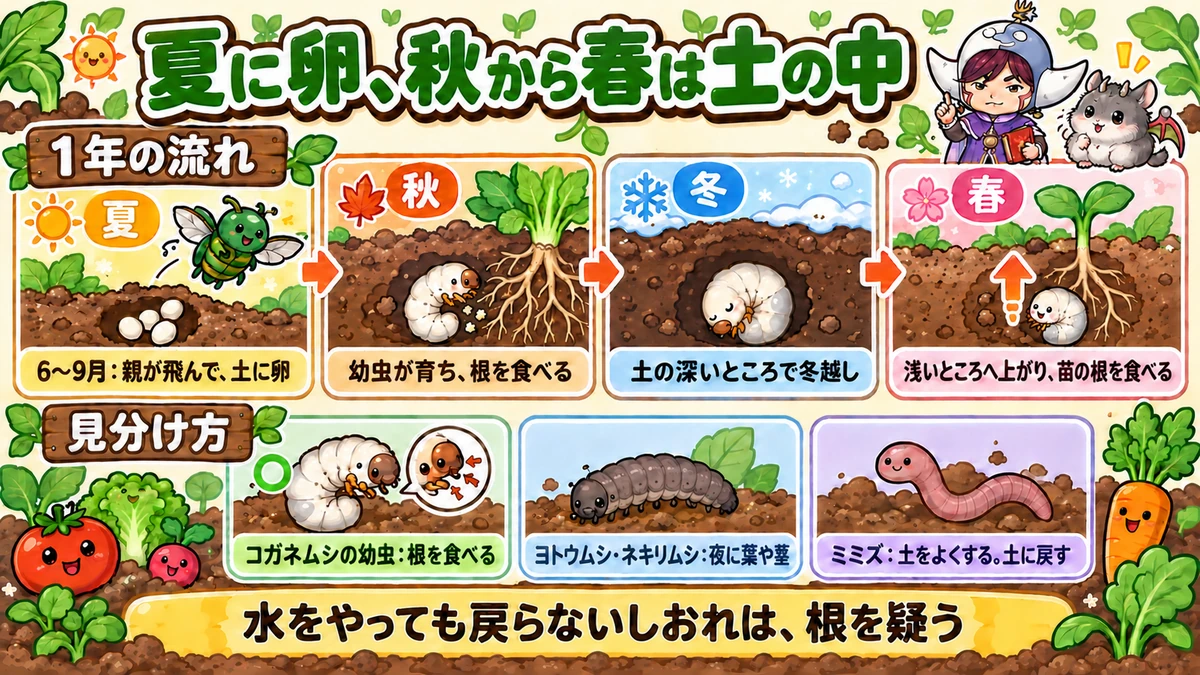
What this diagram says (図解の文字)
- Eggs in summer; in the soil from autumn to spring
- "Summer — June to September: beetles fly and lay eggs in the soil" (central Japan) → "Autumn — grubs grow and eat roots" → "Winter — overwinter deep in the soil" → "Spring — come up near the surface and eat seedling roots"
- "Telling them apart": ◯ "chafer grub: eats roots" / "armyworms and cutworms: eat leaves and stems at night" / "earthworm: improves the soil — put it back"
- "Wilting that water won't fix — suspect the roots"
① What they are
The troublemakers are the larvae of several chafers. In Japan the usual culprits include a coppery chafer, a green chafer, and the Japanese beetle — small, with a shiny green head and thorax and brown wing cases, often in groups on beans and grape leaves. The adults are glossy, metallic green or copper beetles.
Adults fly in during summer to eat the leaves of beans, grapes and the like, and in the evening burrow into the soil to lay. The eggs hatch in about ten days. The grubs of all of them look alike, and the control is the same — no need to tell them apart.
Not to be confused with
- Armyworms and cutworms: dark or brownish caterpillars, slimmer; they curl when touched, come up at night and eat leaves and stems
- Chafer grubs: white and fat, legs only near the head, eat roots underground
- Rhinoceros beetle larvae: look very similar but are much bigger, usually in compost heaps or leaf mould. Size is the easiest clue; a white grub among the roots in your bed is most likely a chafer
- Earthworms: long, legless and stretchy — they make your soil crumbly. Put them back
What they eat
The roots of all sorts of plants. They're said to especially favour sweet potatoes, strawberries and soya beans (edamame), but they'll eat the roots of aubergines, tomatoes, peppers and more. They eat more as they grow — so grubs that grew big over autumn and winter often weaken spring transplants.
② Their year
- Summer — adults lay. They fly from early summer to early autumn, most of all in midsummer, eating leaves by day and burrowing in the evening to lay. They choose soft soil rich in organic matter. Unfinished compost, rotting grass or leaves on the surface attract them to lay — and then feed the hatchlings
- Autumn — grubs grow and start on roots. On sweet potatoes, big grubs build up from early autumn and keep gnawing until harvest, so the later you dig, the more damage. Autumn-planted cabbage, broccoli or strawberries wilting a while after planting may be their work too
- Winter — deep in the soil. They go down and overwinter as grubs, which is why shallow winter digging rarely finds them
- Spring — up to the surface to feed, then pupate. They rise as it warms — just as summer crops are planted. New transplants have few roots, so a little chewing does a lot of harm. Then they pupate and emerge as beetles in early summer: one cycle a year
③ Recognising the damage
- Wilting that water won't fix. A plant that flags on a hot day but recovers by evening after watering is usually just dry. One that stays limp for days after watering likely has a root problem
- Wobbly at the base. Press gently with a finger. A plant that rocks more than when you planted it has few roots, or they've been eaten
- One plant lagging — smaller or paler than the others planted the same day
- Scars on sweet potatoes — shallow gnawed patches and small holes in the skin
- Weeds that pull up easily, roots and all — their roots may have been eaten, and your crops nearby are at risk
Other causes of wilting
- Lack of water: recovers by evening after watering
- Bacterial wilt and other root or stem diseases: the plant doesn't wobble when gripped; a cut stem may be discoloured inside
- Cutworms: the stem chewed through at soil level and the seedling lying flat
- Chafer grubs: wobbly; few roots when pulled; white grubs in the soil round it
Not sure? Grip the base and see if it wobbles.
The adult beetles do damage too
Adults eat the leaves of beans, aubergines, grapes, roses and more — big, bitten-out holes, and some kinds leave a lace of veins. They feed mostly from evening to morning, so you may not see them; look for their droppings, which are larger and more elongated than caterpillars' small round pellets.
- Big bitten-out holes: adult chafers
- Surface scraped to a see-through window: 28-spot ladybirds and similar
- Lots of small round holes: tiny jumping flea beetles
- A net of veins: young armyworms, or some kinds of chafer
In summer, related beetles may also cling to ripe tomatoes and gouge the top of the fruit.
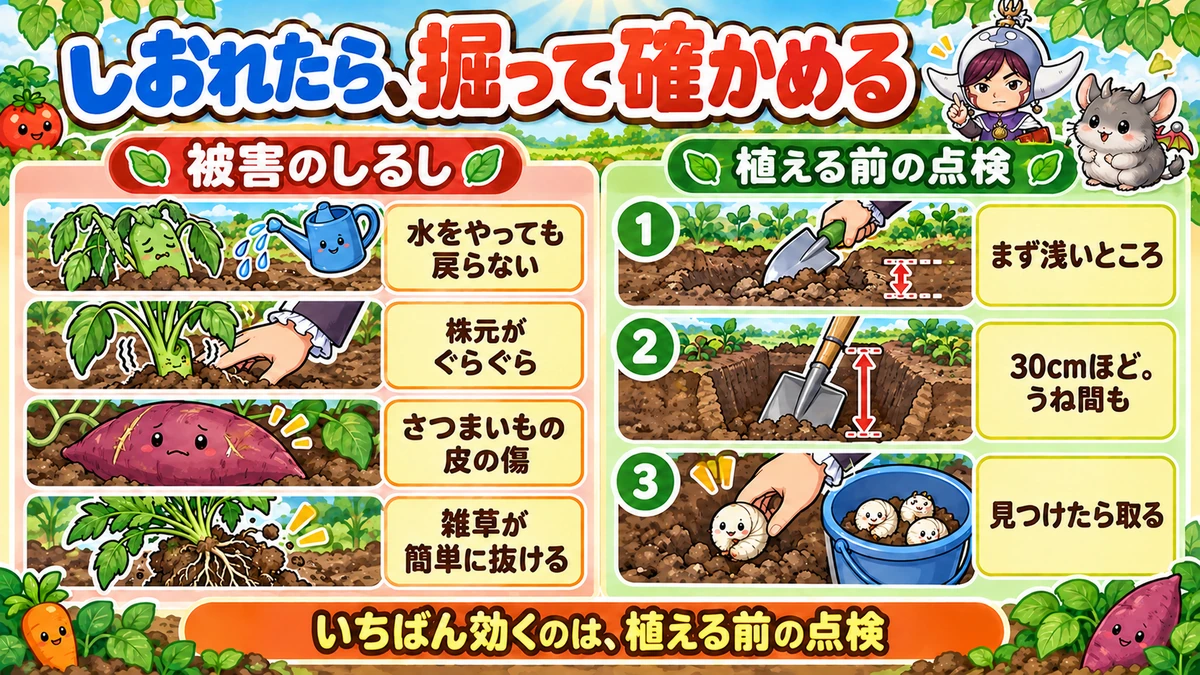
What this diagram says (図解の文字)
- If it wilts, dig and check
- "Signs of damage": "doesn't recover after watering" / "wobbly at the base" / "scars on sweet potato skins" / "weeds pull up easily"
- "Checking before planting": "① shallow layer first" → "② about 30 cm deep — the paths too" → "③ remove any you find"
- "The most effective step is checking before you plant"
④ Finding and removing them
Dig round a wilting plant
Gently loosen the soil with a trowel, starting a little away from the stem, and you'll often find white grubs among the roots — sometimes several per plant. Remove them. Then:
- If a fair amount of root remains: put the soil back, firm it, water well, and watch for a few days. New leaves mean it's recovering
- If the roots are mostly gone: it rarely recovers. Search the soil widely round it for others, then replace it with a spare — always keep a few spare plants
The big one: search before you plant
- Before making the bed, dig to about 1 ft (30 cm)
- Break up the soil a bit at a time as you look
- Remove any white grubs
- Dig the paths between beds too — grubs feeding on weed roots there move across to your crops
Doing this before spring planting and before autumn planting cuts the damage a lot. Already mulched? Just before planting, lift the mulch edge round the planting hole and search there.
A full pre-planting check
This order catches chafer grubs, armyworms, cutworms and pupae in one go:
- Clear the previous crop, lift the mulch, remove old roots and weeds
- Don't dig deep straight away — first work through the top 4–6 in (10–15 cm) with a trowel, so you don't bury the shallow ones
- Then dig a section at a time to about 1 ft (30 cm)
- Break up each clod and look for white grubs, dark caterpillars and brown pupae
- Collect them in a bucket
- Do the paths the same way
- Finally add compost and base fertiliser and make the bed
For a small area or a container, sieving the soil misses fewer. Don't put the grubs back on the plot — some growers leave them where the birds will find them.
⑤ Stopping the beetles laying
No unfinished compost on the surface
Unfinished compost, rotting grass, leaves or rice bran on the surface invite egg-laying.
- Use well-finished compost
- Mix it into the soil rather than leaving it on top
- Don't leave crop waste or cut grass lying on the beds
Organic fertilisers like rice bran, oilseed cake and chicken manure smell as they break down, which attracts all sorts of insects. Work them in 2–3 weeks before planting so they've settled; fertiliser added at the last minute and left on the surface draws pests in.
Cover bare soil in summer
Bare soil in midsummer, when the beetles are laying, is an open invitation:
- Mulch the beds
- Cover the paths with weed-control fabric
- Cover ground you're not using
Covering everything is a lot of work — but even just where grubs are a problem every year, or where sweet potatoes are growing, it can be expected to help.
Other measures
- Solarise: in high summer, water the soil, cover it tightly with clear plastic and leave it about a month. The soil gets very hot, reducing eggs and grubs near the surface, as well as weed seeds and disease
- Insect netting keeps adults out, so they can't lay inside — but it won't help if grubs were already in the soil. Search first
- Pick off adults. Hold a container of water under the leaf and tap it — they fold their legs and drop when disturbed
- Plant transplants early in their window so they're well rooted and can shrug off some nibbling
- Natural enemies: birds drop down to snatch grubs as you dig; moles eat them too. Strong soil insecticides also kill these allies and earthworms
- Look around the plot: weedy waste ground or trees where adults gather to feed nearby send beetles your way. Lawns and flower beds often hold grubs too, and the adults fly from there
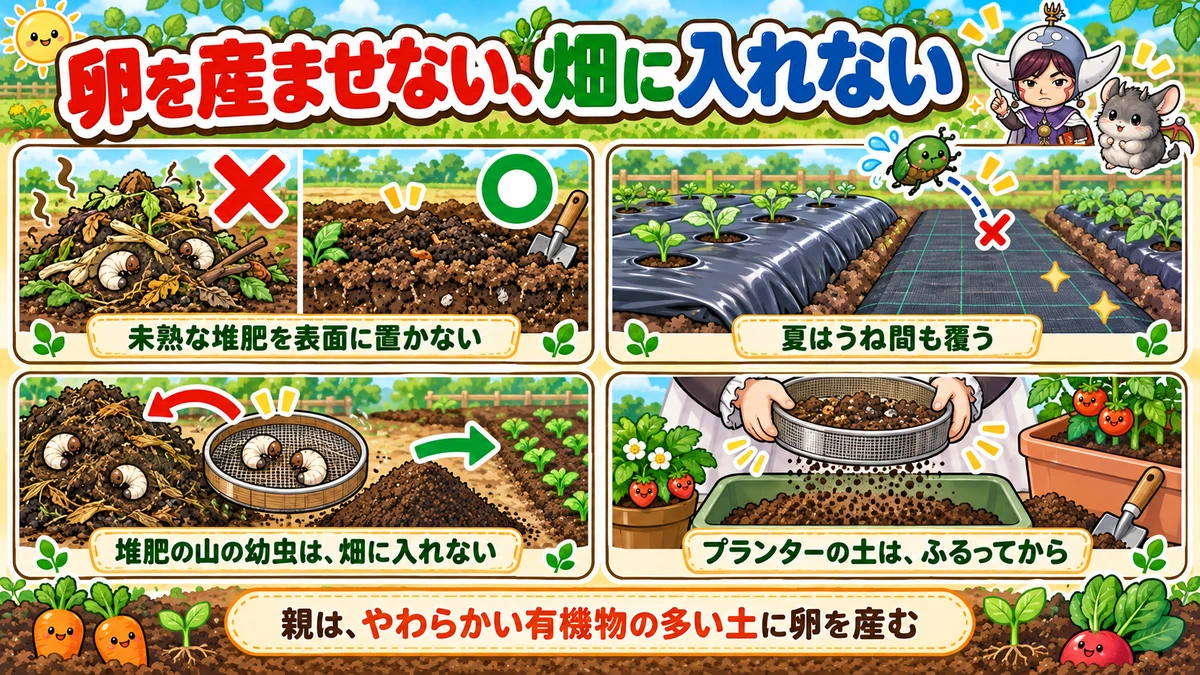
What this diagram says (図解の文字)
- Don't let them lay; don't let them into the beds
- ✕ "Don't leave unfinished compost on the surface" ◯ mixed in
- "In summer, cover the paths too"
- "Grubs from the compost heap stay out of the beds" (sieve them back)
- "Sieve container compost first"
- "Beetles lay in soft soil rich in organic matter"
⑥ The compost heap grubs are workers
Dig into a compost heap or a pile of crop waste and you may find lots of white grubs. There, they're helping — eating crop waste and leaves and turning them into compost, along with earthworms and woodlice. No need to kill them.
The problem is carrying them into the beds with the compost. Sieve compost before you use it and return the grubs and any large unrotted pieces to the heap. Well-finished compost contains hardly any grubs anyway — there's nothing left for them to eat.
⑦ Through the year (central Japan)
- Midwinter: soil cold to depth. Turn over empty ground to the cold; remove any grubs that turn up
- Early to mid-spring: before summer crops go in, dig to 1 ft and search — paths too
- Late spring: watch new transplants; dig round any that wilt or wobble
- Summer: laying season. Cover bare soil and paths; keep unfinished organic matter off the surface; pick off adults; solarise
- Autumn: don't leave sweet potatoes in late. Search before autumn planting
- Early winter: dig over cleared ground and search for grubs
⑧ Crop by crop
Sweet potatoes — the worst affected
- Before planting (late spring): dig to 1 ft and search, paths included
- Making the bed: finished compost only, nothing organic left on top; mulch the bed
- After planting (summer): laying season — cover the paths, no bare soil
- Harvest (autumn): big grubs build up from early autumn and gnaw until you dig — don't harvest late
- Afterwards: remove grubs from the dug soil before the next crop. If damage was heavy last year, consider moving them
Shallow scars can be peeled off thickly; scarred roots don't store well, so eat them first.
- Strawberries: autumn-planted plants can wilt over winter into spring. Wobbly? Dig and check. Search well before planting
- Edamame and other beans: adults eat the leaves, grubs eat the roots. Lacy leaves in summer — look for adults
- Aubergines, tomatoes, peppers: spring transplants can wilt from root damage. Search before planting, plant early
- Cabbage, broccoli and other autumn crops: grubs from summer eggs can attack autumn transplants. Search before autumn planting
- Potatoes, radishes, carrots: gnawing leaves its marks on the crop — shallow holes, scarred skins
⑨ Containers
Adults fly up to balconies and lay in containers too — grow sweet potatoes in a pot and you may find a crowd of grubs at harvest.
- Before reusing compost, tip it out and sieve it; remove grubs and eggs. (See reusing potting compost)
- Compost you won't use for a while can go in a black bag in a sunny spot to heat up. Hot water is another option — mind your hands
- Don't leave unused compost bare over summer — bag and close it, or cover it with a lid or fleece
⑩ Where growers disagree, and common mistakes
- Pest or helper? Root-eater in the bed, recycler in the compost heap. Remove them from the beds, leave them in the heap
- Cover the paths or not? Fewer laying sites — but cost and effort, and some prefer a little weed cover as a home for predators. Cover where damage is bad, or round sweet potatoes
- Does winter digging work? It's said to expose soil pests to the cold, but chafer grubs are deep in winter and hard to reach. It works better on shallow pests such as armyworm pupae; for chafers, pair it with the spring pre-planting check
- Solarise or not? Fewer eggs, grubs and weed seeds — but the ground is out of use and useful soil life suffers. Use it where damage is bad
- Kept watering a wilting plant → roots eaten. If it hasn't recovered in a few days, dig and look
- Dug the beds, not the paths → grubs from the path weeds move over
- Unfinished compost spread on top → an invitation to lay, and food for the grubs
- Compost heap grubs moved into the beds → sieve them back
- Container compost reused as it was → sieve it first
Found one? There are usually more — beetles lay several eggs in one place, so search widely. Moles about? They eat worms and grubs, chafer grubs included — a mole-rich plot is one with lots of soil life (see moles in the garden). Plot overrun year after year? Some growers replace the top 1 ft of soil, but that's a big job — start with the pre-planting check. Grubs but a healthy plant? A big, well-rooted plant may not wilt yet — but the grubs eat more as they grow, so remove them. Shop-bought soil insecticides exist; follow the label exactly if you use one.
Science bit: four whys 🔬
Why live underground? Chafers spend most of their life as grubs in the soil, where temperature and moisture change little and predators find them less easily.
Why are they drawn to unfinished compost? Newly hatched grubs have weak jaws and can't manage living roots yet, so they grow up on soft, half-rotted organic matter. Finished compost has little of that left — so grubs struggle in it. Avoiding unfinished compost denies them their nursery.
Why is spring damage so bad? Grubs moult several times as they grow. Hatched in summer, they're big by winter and at their largest and hungriest in spring — just when transplants have the fewest roots. The hungriest grubs meet the smallest root systems.
Why does eating roots cause wilting? Plants draw up water through fine root hairs at the root tips — the soft parts grubs prefer. Without them the plant can't take up water, so no amount of watering helps.
To sum up
- ✅ Fat, white, C-shaped grubs in the soil are chafer larvae — they eat roots
- ✅ Wilting that water won't fix, wobbly plants, scarred sweet potatoes
- ✅ Beetles lay in summer in soft, organic-rich soil
- ✅ Grubs go deep for winter and come up to feed in spring
- ✅ Dig to 1 ft and search before planting — paths too
- ✅ No unfinished compost or rotting grass on the surface
- ✅ Cover bare soil and paths in summer
- ✅ Compost heap grubs are workers — sieve, don't bring them in
- ✅ Wilting plant? Dig and check; replace it if the roots are gone
- ✅ Sieve container compost before reuse
- ✅ Plant early, keep spares, work organic fertiliser in 2–3 weeks ahead
Chafer grubs are out of sight, so damage often comes first. But once you know their year, you know when to act. Before your next planting, dig a spadeful and have a look 🪲
Thank you for reading!