Armyworms and cutworms: the caterpillars that eat at night 🐛 Finding them, removing them, and protecting your plants

🐛 "A seedling that was fine yesterday was lying flat this morning."
🐛 "My cabbage is full of holes, but I can't find a single caterpillar."
🐛 "Overnight, the leaves were stripped to the veins."
Hello, I'm Eiko. Eight years of growing vegetables organically and without pesticides, and a teaching licence in science.
Much of that damage is done by caterpillars that feed at night. Walk round by day and there's nothing to see, so you can't tell what's eating your plants, and you're always one step behind.
This article covers two of them — armyworms, which eat leaves, and cutworms, which fell seedlings — from telling them apart to finding them, removing them without sprays, prevention, and how to cut their numbers in winter.
Armyworms eat leaves. Young ones cluster under a leaf; older ones hide in the soil or between leaves by day and feed at night. Cutworms chew through young stems at soil level and lie curled in the top of the soil by day. Both are moth caterpillars.
Worst times (central Japan): armyworms in spring and especially autumn, as cabbages and Chinese cabbages start to heart; cutworms just after spring and autumn planting. Clues: egg clusters under leaves, see-through "windowed" leaves, black or green droppings, seedlings felled at the base.
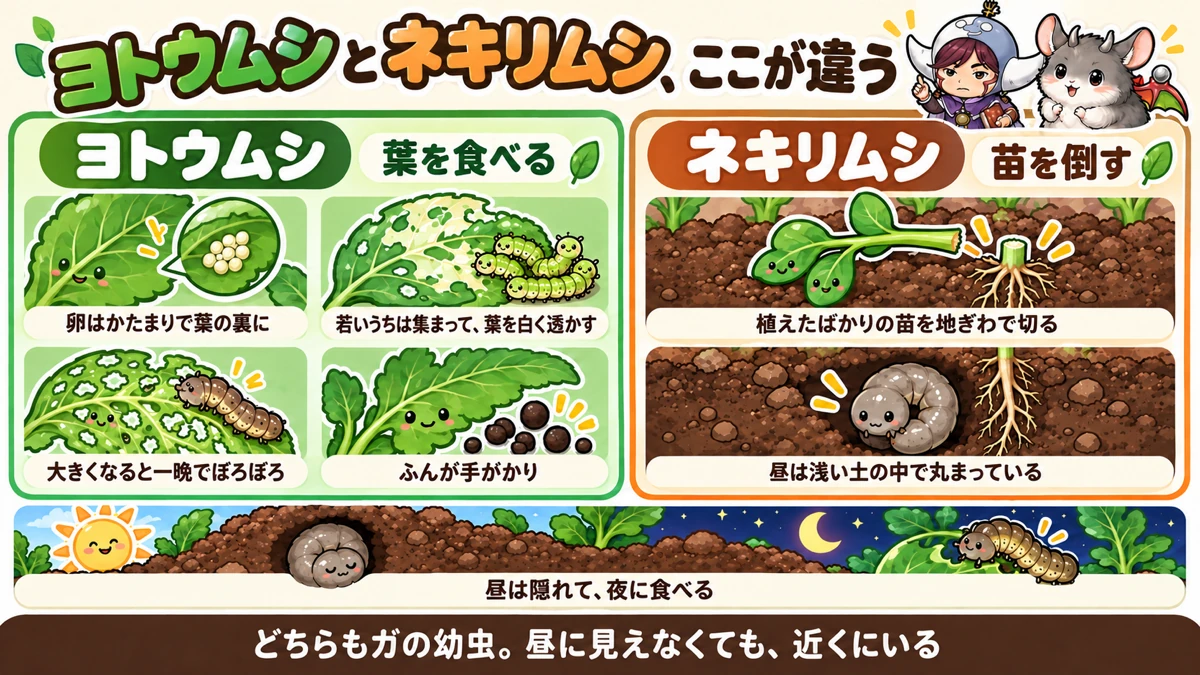
What this diagram says (図解の文字)
- Armyworms and cutworms — here's the difference
- "Armyworm: eats leaves" — "eggs in a cluster under the leaf" / "young ones cluster and make the leaf see-through" / "bigger ones shred it overnight" / "droppings are the clue"
- "Cutworm: fells seedlings" — "cuts newly planted seedlings at soil level" / "curled up in shallow soil by day"
- "Hidden by day, feeding by night"
- "Both are moth caterpillars. You can't see them by day, but they're close by"
① Armyworms
The Japanese name means "night thief" — hiding by day, eating vegetables by night. Several moth caterpillars go by the name; in home gardens, the commonest are the cabbage moth caterpillar, the tobacco cutworm (cotton leafworm), and the beet armyworm. They differ a little in looks and timing, but share the same habits — young ones cluster under leaves, older ones hide and feed at night — and the same solutions.
They eat almost anything. Brassicas — Chinese cabbage, cabbage, broccoli, radish — are favourites, but lettuce, spinach, aubergines, peppers, beans and taro are all on the menu.
Looks: newly hatched, they're tiny and green, a lot like cabbage white caterpillars. As they grow they turn brown or blackish, and big ones pass 1¼ in (3 cm) — stout and grub-like.
How their feeding changes
- Eggs: the moth lays dozens to hundreds in a neat cluster under a leaf, sometimes covered in hairs
- Just hatched: they feed together round the egg cluster, eating the underside but leaving the top skin — a spreading white, see-through patch from above
- A bit bigger: they scatter and start eating holes
- Big: hiding by day in the soil at the base or between overlapping leaves, they come out at night and can strip a plant in one night, leaving a net of veins
How much they eat shoots up as they grow. So the cheapest moment to act is the see-through leaf stage — while they're still together.
Their year
The cabbage moth overwinters as a pupa in the soil, flies in spring and lays on spring crops; it pupates again through the summer heat and flies again in early autumn to lay on autumn and winter crops — two generations, spring and autumn. The tobacco cutworm starts building up in late summer and peaks in autumn; it's said to be worse after a hot, dry summer.
② Cutworms
Cutworms are the caterpillars of moths such as the turnip moth. Despite the Japanese name ("root-cutter"), they eat the stem at soil level, not the roots — coming out of the soil at night and chewing through the stem right at the surface. Dark and grub-like, they curl up when touched.
Newly planted seedlings are the target. Thin, soft stems can be felled several at a time in one night. A seedling lying flat in the morning with no culprit in sight is almost certainly a cutworm — look at the base and you'll see the stem chewed through. Once stems thicken and harden, they're rarely cut, so protection is about the weeks between planting and a sturdy stem.
The moths are said to lay eggs one or two at a time near the base of weeds and crops — not in big clusters — so finding the eggs isn't practical.
③ Finding them
- 1. Egg clusters under leaves. The easiest stage. After planting autumn crops, turn over a few outer leaves. A cluster of neatly packed tiny beads is likely moth eggs — pick the leaf and bag it. Losing one outer leaf barely affects the plant
- 2. See-through leaves. A whitish, translucent patch from above means newly hatched caterpillars underneath. They're still together, so removing the leaf removes most of them in one go — bag it or tread on it
- 3. Droppings. Little black or green pellets on leaves, leaf bases or mulch mean caterpillars nearby. On cabbages and Chinese cabbages, gently open the leaves one at a time from the outside in — in hearting plants they get right into the young central leaves. Still nothing? Look at the soil. Pick off the droppings with tweezers; fresh ones later tell you it's still there
- 4. Scratch the top of the soil. Big armyworms and cutworms hide by day only a few centimetres down. Gently loosen the soil round damaged or felled plants with a finger or trowel — round the planting holes if there's mulch, and under the mulch too. They're soil-coloured, so go slowly. If one seedling has been felled, check its neighbours — they can work along a row in a night
- 5. Go out after dark with a torch and catch them feeding — worth trying for a plot near home or containers
A routine for autumn brassicas
- Lift one side of the net — no need to remove it
- Look over each plant for holes, see-through leaves and droppings
- Turn over a few outer leaves for egg clusters and young caterpillars
- On cabbages and Chinese cabbages, gently open the leaves from outside in, right to the centre on hearting plants
- Droppings but no caterpillar? Loosen the soil round the planting hole about ½ in (1 cm) deep
- Put the net back and bury the edge
From planting until hearting, check twice a week if you can, at least weekly. Damage peaks as cabbages and Chinese cabbages start to heart — just when you might think the plants are big enough to cope. That's when to look hardest.
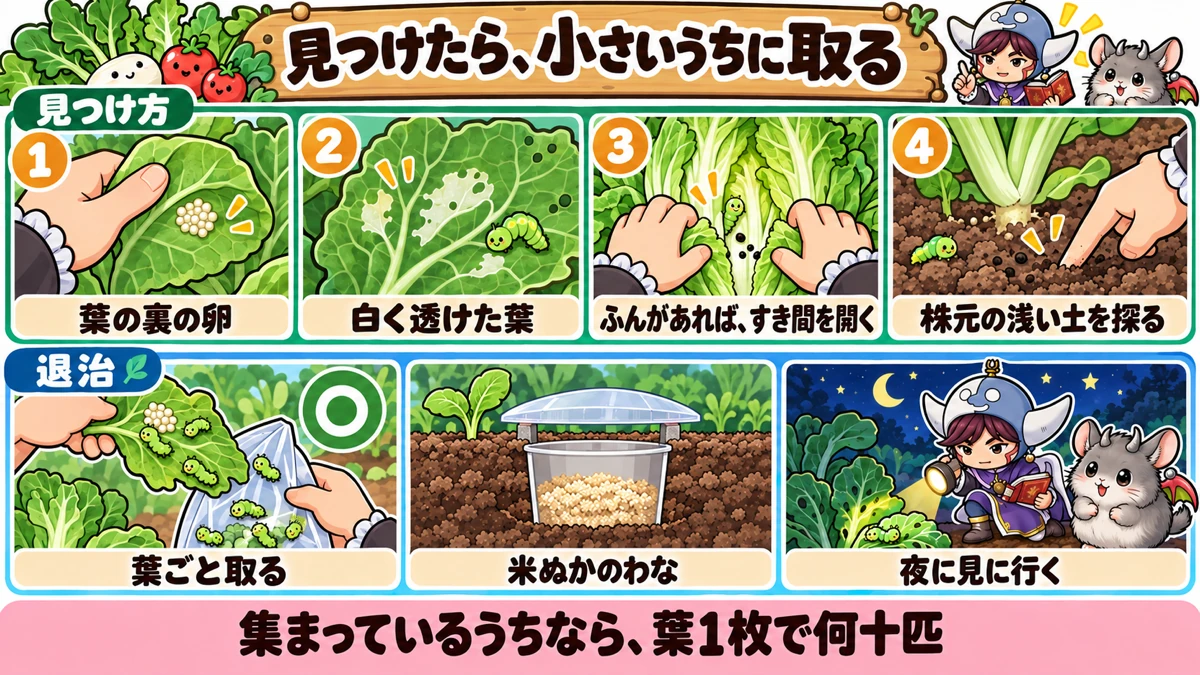
What this diagram says (図解の文字)
- When you find them, remove them while they're small
- "Finding them": "① eggs under the leaf" / "② see-through leaves" / "③ droppings — open up the gaps" / "④ search the shallow soil at the base"
- "Removing them": ◎ "take the whole leaf" / "rice-bran trap" / "go and look at night"
- "While they're still together, dozens on a single leaf"
④ Removing them without pesticides
- Take eggs and young caterpillars with the leaf. The most effective step of all — before they scatter, one leaf can hold dozens. Bag the leaf; don't leave it on the plot
- Pick off bigger ones as you find them, with chopsticks or tweezers if you prefer
A rice-bran trap
Armyworms are said to be drawn to the smell of rice bran:
- Put rice bran in a paper cup
- Bury it about 4 in (10 cm) from the plant, rim level with the soil or mulch
- Prop a lid over it with a gap, so rain doesn't soak and rot the bran
- Check every 3–4 days and remove what's inside
A plastic bottle with caterpillar-sized holes in its side and bran inside works too. Traps won't catch them all — use them alongside checking.
Moth traps
When the moths are flying, some growers hang a bottle with windows cut in the side, holding a mix of spirits, vinegar and sugar; moths drawn to it fall in. Catching moths before they lay means fewer caterpillars — but results vary, and it's no substitute for netting and checks. Think of it as a bonus.
Microbial products
If you'd rather avoid chemical pesticides but can't keep up by hand, there are shop-bought microbial products that act only on caterpillars; some are approved for organic growing. Follow the label exactly.
⑤ Prevention
Netting from planting day
The moths fly in and lay on the leaves. Net the crop the day you plant and bury the edges. Caterpillars can still end up inside if:
- Eggs were already on the plants when you bought them
- There were gaps at the edges or seams
- Pupae or caterpillars were already in the soil — they can hatch into moths and lay inside the net
Check under the leaves before netting, and lift the edge and look inside weekly. Moths are big, so they're kept out even by coarse mesh — but autumn brassicas also face flea beetles and aphids, so a finer mesh is often used. Finer mesh is stuffier, so watch for overheating in early autumn, and set the net high enough that the leaves won't touch it as they grow.
Collars against cutworms
Cutworms crawl along the surface to reach the stem. Ring the stem so they can't get to it:
- A toilet-roll tube or a 2 in (5 cm) ring cut from a plastic bottle, set over the seedling and pushed about 1¼ in (3 cm) into the soil
- Or a thick drinking straw cut to 1¼–1½ in (3–4 cm), slit lengthways and slipped round the stem, pushed in only a little — deep pushes damage the roots
Keep them on until the stem has thickened. Some growers scatter crushed eggshell round the base, on the idea that they avoid the sharp edges.
Weeds, plants and other ideas
- Clear weeds from the bed and its edges before planting — cutworm moths lay at the base of weeds, and weeds hide all sorts of pests. Take pulled weeds off the plot rather than digging them in with any eggs and caterpillars on them
- Check bought plants under every leaf before planting
- Marigolds: some growers report fewer soil pests after growing them, or digging cut marigolds into the paths. Not a well-established effect
- Natural enemies: birds, spiders, frogs and parasitic wasps all eat or attack them — birds will drop down beside you as you dig to snatch caterpillars. Sprays reduce them too; hand-picking, traps and netting keep your garden friendly to them
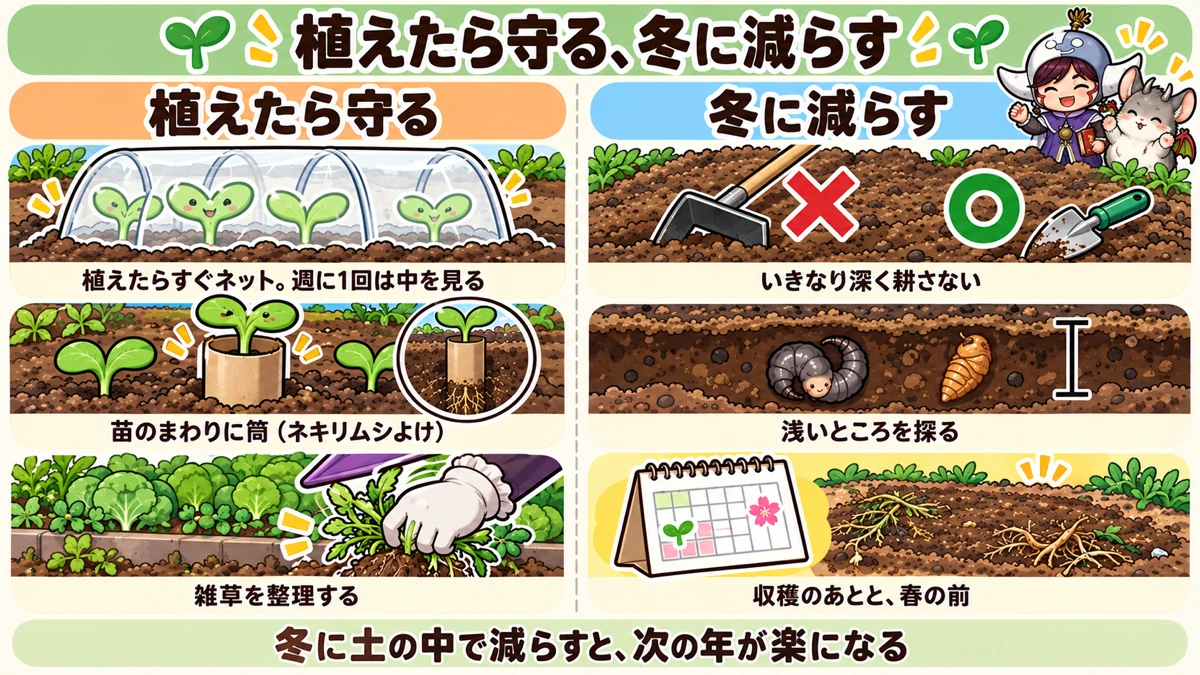
What this diagram says (図解の文字)
- Protect at planting, reduce them in winter
- "Protect at planting": "net straight after planting; look inside once a week" / "a collar round the seedling (against cutworms)" / "clear the weeds"
- "Reduce in winter": ✕ "don't dig deep straight away" ◯ "search the shallow soil" / "after harvest, and before spring"
- "Cut their numbers in the soil in winter and next year is easier"
⑥ After harvest and in winter
By early winter, armyworms seem to vanish — but they're pupae in the soil, waiting to emerge as moths in spring. The worse the autumn damage, the more are probably down there. Reducing them before you plant in spring is the best way to reduce next year's damage.
Search the top layer before you dig
After the autumn crops are cleared, don't dig deep straight away — that buries the shallow ones, to emerge in spring. First work through the top 4–6 in (10–15 cm) with a trowel, a little at a time:
- Lift any mulch and search underneath — it's warm there and they gather
- Start round the worst-damaged plants
- Cabbage moth pupae are brown, hard-cased and about ¾ in (2 cm) long, and blend in with the soil — go slowly
- Remove any caterpillars and pupae you find
Under winter tunnels they stay nearer the surface because it's warmer; elsewhere, look a little deeper. Turning empty beds over in the cold exposes them to frost and birds.
Hot water: some growers pour boiling water over the surface where damage was bad and nothing could be found. It also harms useful soil life and nearby roots, and there's a scald risk — only on empty ground, carefully. Hand-searching comes first.
Search once more before spring planting, especially where last autumn was bad — it reduces cutworm damage to new transplants.
The year at a glance (central Japan)
- Midwinter: pupae and caterpillars in the soil. Turn over empty ground to the cold
- Late winter: before it warms up, search under mulch and in the top layer — a key moment
- Mid to late spring: moths fly and lay. Net and collar new transplants. Cutworm season
- Early summer: spring caterpillars on the leaves. Check under them
- High summer: cabbage moths pupate through the heat; tobacco cutworms start building in late summer
- Early to mid-autumn: moths lay on autumn crops. Net at planting; look for egg clusters and see-through leaves. Tobacco cutworms peak
- Late autumn: cabbages and Chinese cabbages heart — check the gaps and droppings carefully
- Early winter: caterpillars harder to see. After harvest, search shallow before digging deep
Act at two times: when moths fly in spring and autumn, and when they're in the soil from winter to early spring.
⑦ After the damage
- If the growing point is intact, it recovers. Even with outer leaves riddled, a cabbage whose centre is unharmed grows new leaves. If the centre's eaten, it may stall — and a heading crop may never heart
- Remove leaves reduced to a net of veins — they barely photosynthesise. Check underneath for eggs and caterpillars first
- A felled seedling won't recover. Keep a few spares when planting. Before replanting, search the soil round it — the culprit is still there — and give the new seedling a collar
⑧ Telling them from other pests
- Lots of small round holes all over: flea beetles — tiny jumping beetles
- Leaves netted, with small dark larvae and beetles: a leaf beetle that comes in from wild brassica weeds — clear those weeds
- The heart or growing point eaten, with something burrowed inside: the cabbage webworm. Check the centre closely
- All-green caterpillar on the leaf even by day: cabbage white caterpillar
- White see-through patches with a crowd of small caterpillars beneath: young armyworms
- Big holes, veins left, lots of droppings, nothing visible by day: older armyworms
⑨ Crop by crop
- Chinese cabbage and cabbage: once they heart, caterpillars inside are invisible. Catch eggs and see-through leaves on the outer leaves before then
- Broccoli, radish, komatsuna: favourites. Net and check undersides; with radish, search the soil at the base too, as the leaves lie close to the ground
- Lettuce: cutworms can fell it at the base; lift the fallen leaves and the culprit may be underneath
- Aubergine, pepper and tomato seedlings: collars until the stems thicken
- Edamame and other beans: remove see-through leaves whole
- Taro: tobacco cutworms love to lay on the huge leaves. A see-through taro leaf in late summer means a crowd underneath
- Balcony leafy crops: moths fly up there too, and with few plants each loss shows. Cover containers with fine fleece or netting
⑩ Where growers disagree, and common mistakes
- How well do traps work? "Far fewer" from some, "hardly caught anything" from others — it depends on the plot and the numbers. Use them as a help
- Hot water? Effective on shallow pests, but harms soil life. Hand-search first; keep hot water for problem spots on empty ground
- Can a big plant afford a little damage? Some say yes. But armyworms eat more and more as they grow, so "it's only a little" doesn't stay true for long
- Checked by day, saw nothing → they're hiding. Damage or droppings mean they're close
- Netted and relaxed → they bred inside from soil or bought plants
- Missed the see-through leaf → one leaf would have done it; now they've scattered and grown
- Dug deep straight after harvest → buried them to emerge in spring
- Replanted without searching → the culprit's still there
Cabbage white or armyworm? Cabbage whites sit on the leaf in daylight and are green all over; young armyworms are green too but crowd under leaves, and older ones turn brown and hide. Chafer grub or cutworm? Chafer grubs are whitish, C-shaped, and eat roots underground; cutworms are dark and come up at night to chew stems. Can you eat damaged cabbage? Yes — remove caterpillars and droppings, peel off the damaged outer leaves and wash well.
Science bit: life as a night feeder 🔬
Why at night? Caterpillars are soft and slow. On a leaf in daylight, birds and wasps find them easily. Hiding by day and feeding in the dark is how they survive — and they switch to it as they grow, because bigger caterpillars are easier to spot.
Why do young ones cluster? The moth lays all her eggs in one place. Newly hatched caterpillars have weak jaws, so they graze the soft underside of the leaf right where they hatched, and only spread out once they're bigger. For us, that clustered stage is the easiest moment to deal with them — which is why the see-through leaf is the key clue.
Why worse in autumn? Some kinds go through several generations a year. The tobacco cutworm multiplies with each generation from late summer and peaks in autumn — right when autumn crops are planted. Hence netting new plants at once.
Why overwinter as pupae? A caterpillar can't feed or move in the cold. A pupa needs no food and can sit out the cold, and the soil changes temperature far less than the air. Turned around: in winter they're stuck in the shallow soil, defenceless — which is exactly when searching pays off.
To sum up
- ✅ Both are moth caterpillars that hide by day and eat at night
- ✅ Armyworms eat leaves; young ones make see-through patches
- ✅ Cutworms fell new seedlings at soil level
- ✅ Take egg clusters and see-through leaves whole — the easiest win
- ✅ Damage but no caterpillar? Open the leaf gaps and scratch the top of the soil
- ✅ Net at planting, collar the stems, clear weeds
- ✅ Rice-bran traps as a help
- ✅ Hearting cabbages need the closest watch
- ✅ After harvest, search shallow before digging deep; again before spring
- ✅ An intact growing point recovers; replace felled seedlings after searching round them
Night feeders are frustrating because you never see them — but they always leave clues: damage and droppings. Next time you walk round, turn over a few outer leaves 🐛
Thank you for reading!